Expert analysis of El Greco’s The Resurrection
Style: Mannerism (Late Renaissance) · Genre: religious painting
Expert Art Historical Analysis: "The Resurrection" by El Greco
Context and Style
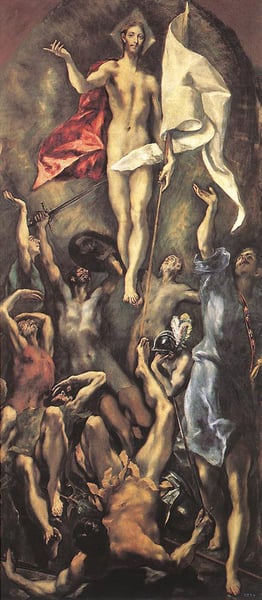
Painted during El Greco’s Spanish period (c. 1577–1614), The Resurrection exemplifies the Mannerist tendencies of the Late Renaissance—a deliberate departure from the harmonious naturalism of the High Renaissance. El Greco, originally trained in the Byzantine icon tradition and later influenced by Venetian colorism and Roman Mannerism, fused these elements into a singular, intensely spiritual vision. In Spain, his work became a vehicle for Counter-Reformation religious fervor, prioritizing emotional transcendence over physical realism.
Composition and Technique
The painting presents a vertically soaring composition, typical of Mannerist structure, with Christ at the apex, rising dramatically from the sarcophagus. El Greco’s signature elongation of figures—twisting, flame-like bodies—creates a sense of supernatural motion. The guards at the base are shown in contorted poses, their forms compressed and drained of earthly solidity, underscoring the miraculous event. The brushwork is loose and expressive, with sharp, acidic colors (luminous yellow-greens, pale pinks, deep blues) that do not mimic natural light but instead evoke a divine, otherworldly radiance. The sky churns with abstracted clouds, reinforcing the spiritual turbulence.
Significance
-
Mannerist Exaggeration for Mystical Effect: El Greco’s distortion—elongated anatomy, discordant proportions, and spatial ambiguity—is not a failure of skill but a deliberate tool to convey the ineffable. Christ’s body, stretched upward, appears weightless, defying gravity to emphasize His triumph over death. This anti-classical approach was radical for its time and prefigures Expressionist and modernist sensibilities.
-
Synthesis of Traditions: The work fuses Byzantine hieratic symmetry (the frontal, iconic Christ) with Venetian painterly richness and Mannerist intellectualism. This synthesis was unique to El Greco and made him a solitary figure, misunderstood in his own era but later celebrated as a proto-modernist.
-
Counter-Reformation Piety: In a period when the Catholic Church demanded emotionally engaging art to reassert doctrine, El Greco’s Resurrection appeals directly to the soul. The lack of a naturalistic setting forces the viewer to focus on the miracle itself, making faith the only plausible interpretation.
-
Influence on Modern Art: The painting’s flattened space, distorted figures, and intense color field directly inspired 20th-century artists like Picasso, Pollock, and the German Expressionists. El Greco’s subjective, inner vision challenged the Renaissance ideal of objective representation, marking a critical turning point in Western art.
In sum, The Resurrection is a masterpiece of Mannerist spirituality, where formal distortion becomes the language of the sublime. It stands as a bridge between the Renaissance and modernity, forever altering how art can express the divine.
Museum / Gallery
Visually similar
20 works with related composition and palette
The Resurrection
El Greco
Resurrection
El Greco
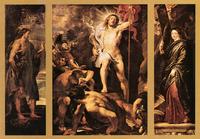
The Resurrection of Christ
Peter Paul Rubens
The Brazen Serpent
Benjamin West
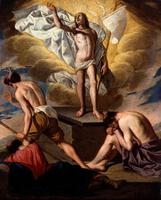
Auferstehung Christi
Juan Bautista Maíno
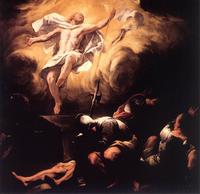
Resurrection
Luca Giordano
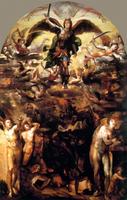
The Fall of the Rebel Angels
Domenico Beccafumi
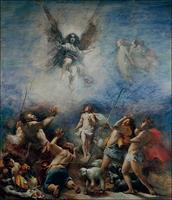
Gloria in Excelsis Deo
Frank Mason
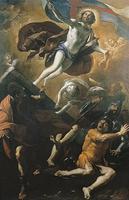
La Resurrección de Cristo
Giovanni Lanfranco
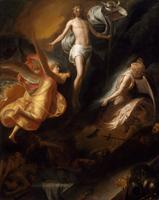
Resurrection of Christ
Samuel Dirksz van Hoogstraten
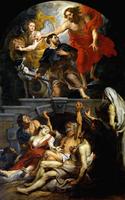
Christ appointing Saint Roch as patron saint of plague victims
Peter Paul Rubens
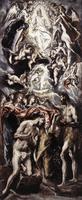
Baptism of Christ
El Greco
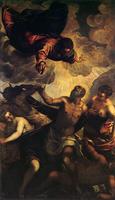
The Temptation of St Anthony
Tintoretto
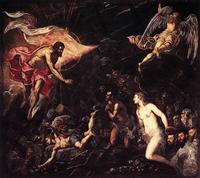
The Descent into Hell
Tintoretto
Crucifixion (detail)
Palma il Giovane
Samson and the Philistines
Giulio Cesare Procaccini
Resurrection
Francesco Stringa
Ecce Homo
Giulio Cesare Procaccini
Ecce Homo
Giulio Cesare Procaccini
La Conversion De Saint Paul
Giovanni Battista Gaulli