Analyse experte de The Origin of the World de Gustave Courbet
Style : Realism · Genre : nude painting (nu)
Expert Analysis: "The Origin of the World" (1866) by Gustave Courbet
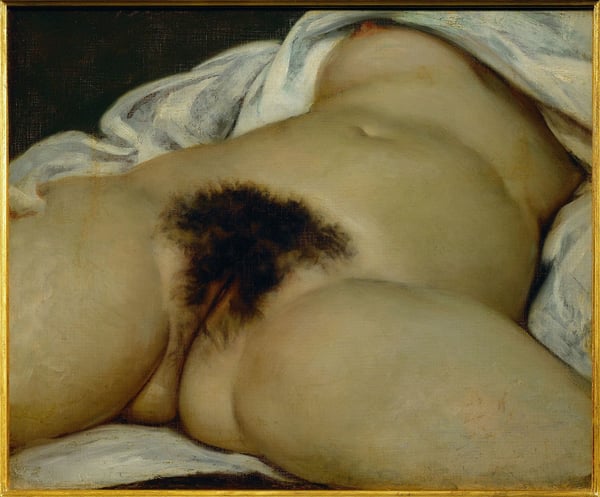
Gustave Courbet’s The Origin of the World stands as one of the most audacious and radical works of 19th-century art, a defining moment in the Realist movement. Painted in 1866, this intimate, close-cropped nude depicts a female torso with legs parted, focusing exclusively on the genitalia and lower abdomen—an unprecedented directness that shattered conventions of academic and mythological nudity.
Significance within Realism
Courbet’s Realism rejected the idealized, sanitized nudes of Neoclassicism and Romanticism (e.g., Ingres’s La Grande Odalisque or Titian’s Venus of Urbino), which typically presented the female body as remote, allegorical, or morally elevated. Instead, The Origin of the World refuses any narrative or mythological excuse. The model is unnamed, the setting ambiguous—she is simply a body, unposed in the classical sense. This aligns with Courbet’s dictum: “Show me an angel and I will paint one.” Here, he shows a truth of the flesh: raw, anatomical, and unapologetically corporeal.
The painting’s genre—nu (nude) as opposed to académie or figure peinte—underscores its break from institutional tradition. By eliminating the face and any expressive features, Courbet erases individual identity and refuses the viewer the comfort of psychological engagement. The gaze is forced downward, onto the physical origin of life itself.
Provocation and Legacy
Commissioned by the Ottoman-Egyptian diplomat Khalil Bey (who also owned Ingres’s Le Bain Turc), the work was hidden behind a green curtain for decades, revealed only to a select few. Its explicit nature scandalized even Courbet’s contemporaries. Yet it is precisely this refusal to soften reality that makes it a cornerstone of Realist radicalism.
Technically, Courbet employs a lush, thick impasto and earthy, warm tonalities—creamy whites, deep shadows, and touches of red—that emphasize tactility. The brushwork is loose but deliberate, capturing the softness of skin and the sheen of light. The composition is radically cropped, as if seen through a keyhole, heightening immediacy.
Significance Today
The Origin of the World remains a touchstone for discussions of representation, the male gaze, and the politics of the body. It anticipated later modernist provocations (e.g., Manet’s Olympia, Duchamp’s Étant donnés) and continues to challenge notions of what can be shown in art. In the context of Realism, it is the ultimate statement: a work that refuses to look away from the most fundamental, and most hidden, truth of human existence.
Museum / Gallery
Visuellement similaire
20 œuvres à la composition et à la palette proches
Czene Béla, Fevő Nő , . ,
Czene Béla
Female nude
Cesare Tallone
Reclining Female Nude
Émilie Charmy
Portrait on a Grey Cover
Lucian Freud
Naked Portrait
Lucian Freud
Nude with Coral Necklace
Amedeo Modigliani
Reclining Nude
Zinaida Serebriakova
Sleeping nude
Zinaida Serebriakova
Nude of a woman
Antonio Sicurezza
Sleeping Woman
Karoly Ferenczy
Susanna
Antonio Sicurezza
Esther
Lucian Freud
Study for the figure of "Spring" at l'Opéra-Comique, Paris
Luc-Olivier Merson
Sleeping Nude Woman
Gustave Courbet
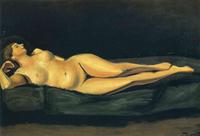
Female nude
Andre Derain
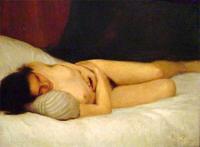
Female nude
Eliseu Visconti
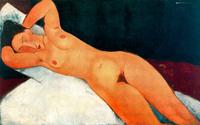
Nude with Necklace
Amedeo Modigliani
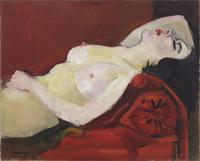
Nude on Red Sofa; Sleeping Nude
Émilie Charmy
Reclining nude
Amedeo Modigliani
Reclining nude
Amedeo Modigliani