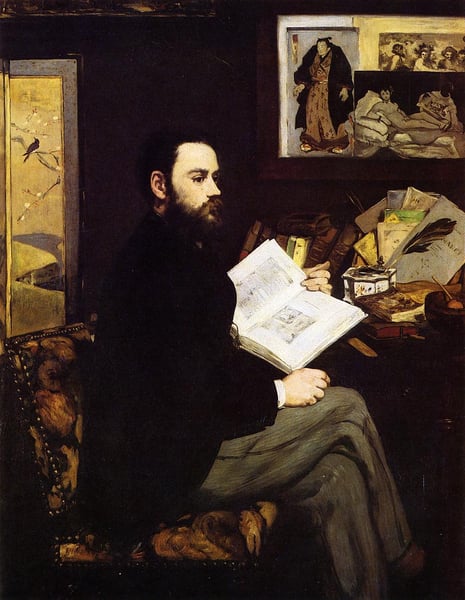
Portrait of Emile Zola
Dettagli
Analisi esperta di Portrait of Emile Zola di Edouard Manet
Stile: Realism · Genere: portrait
Expert Analysis of "Portrait of Emile Zola" by Édouard Manet
As an artwork firmly grounded in the Realist movement, Manet’s Portrait of Emile Zola stands as a landmark of mid-19th-century portraiture. Executed in 1868, the painting embodies the core Realist principles of truthfully depicting contemporary life and rejecting idealized, academic conventions. Manet portrays the writer Émile Zola—a fierce advocate of Realism in literature and a vocal defender of Manet’s own controversial works—not as a remote, heroic figure, but as an engaged intellectual at work in his study.
The portrait’s significance within the Realist period lies in its directness and its deliberate inclusion of symbolic objects that anchor the sitter in the modern world. Zola is shown seated at a desk, surrounded by books, a quill, and a Japanese screen and print—elements that signal both his literary vocation and his role as a champion of avant-garde art. By incorporating these everyday details, Manet transforms the portrait from mere likeness into a manifesto of Realist values: the subject is defined by his actual environment and his cultural contributions, not by allegorical trappings.
Moreover, the composition breaks with traditional portrait conventions of the era. Manet uses a flattened, slightly compressed space and a muted, earthy palette, emphasizing tonal contrasts rather than smooth gradations. This technique—typical of Manet’s Realist approach—challenges the polished finish of academic painting and foregrounds the artist’s hand, aligning with Realism’s insistence on unvarnished observation. The presence of a reproduced print of Manet’s own Olympia in the background further blurs the line between portrait and self-referential commentary, celebrating the mutual reinforcement of Realist painting and writing.
In essence, this work is significant because it encapsulates Realism’s dual commitment: to depict a specific, contemporary individual with uncompromising fidelity, and to assert the intellectual and cultural relevance of the movement itself. Manet’s portrait of Zola thus stands as a historic alliance between painter and writer, and as a definitive example of how Realist portraiture could capture both a person and the spirit of an era.
Museum / Gallery
Visivamente simili
20 opere con composizione e palette affini
Portrait of the Composer Nikolay Rymsky-Korsakov
Ilya Repin
Portrait of Stjepan Nikolsky, uncle of the artist
Boris Kustodiev
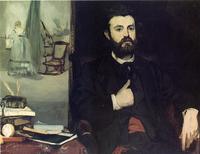
Portrait of Zacharie Astruc
Edouard Manet
Robert Spence Watson
Ralph Hedley
Portrait of Henri Cordier, teacher at the School of Oriental Languages
Gustave Caillebotte
Portrait Of Don Aureliano De Beruete
Joaquín Sorolla
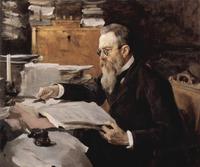
Portrait of Nikolai Andreyevich Rimsky-Korsakov
Valentin Serov
David John Harrison (1820–1893)
William Banks Fortescue
Portrait of Charles Linford, the Artist
Thomas Eakins
Portrait of the Artist Nikolay Gay
Ilya Repin
Portrait of Efim Repin, the Artist's Father
Ilya Repin
Portrait of Alexandre Benois
Leon Bakst
Adrian Prakhov
Oleksandr Murashko
Old man reading a book
Joaquín Agrasot
Emile Verhaeren in His Study
Theo van Rysselberghe
Antonin Proust
Anders Zorn
Portrait of Emmanuel, Son of the Artist
Benjamin Constant
Aureliano de Beruete
Joaquín Sorolla
Portrait of writer Vsevolod Mikhailovich Garshin
Ilya Repin
Man Reading
Georges Lemmen