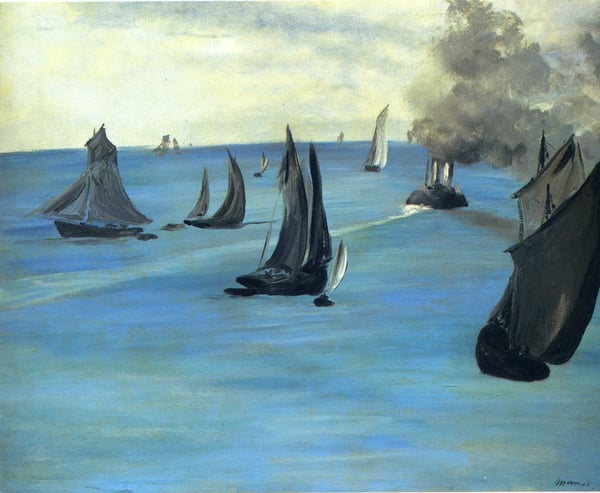
Edouard Manet sanatçısının Steamboat leaving Boulogne eseri hakkında uzman analizi
Tarz: Realism · Tür: marina
Expert Analysis of "Steamboat leaving Boulogne" by Édouard Manet
Within the context of 19th-century French art, Édouard Manet occupies a unique and revolutionary position—a bridge between the entrenched traditions of Realism and the emerging impulses of Impressionism. Steamboat leaving Boulogne (c. 1864) exemplifies this transitional moment while firmly grounding itself in the Realist movement through its unidealized depiction of contemporary modern life.
Significance within Realism and the Marina Genre
As a marina, the painting belongs to a long tradition of seascapes, yet Manet subverts the expected conventions. Rather than a grand historical or mythological maritime scene, he presents a straightforward, almost snapshot-like view of a modern steamboat departing from the bustling port of Boulogne. This choice is quintessentially Realist: it celebrates the everyday, the industrial, and the transient. The steamboat—a symbol of industrial progress and modern travel—replaces the romantic sailing vessels favored by earlier artists, aligning Manet with Gustave Courbet’s insistence on depicting the artist’s own time.
Visually, the work demonstrates Manet’s radical approach to composition and paint handling. The strong horizontal lines of the sea and sky are punctuated by the vertical smokestacks and masts, creating a deliberately flattened, almost diagrammatic arrangement. This flattening of space, combined with broad, visible brushstrokes and areas of unmodulated color (especially in the water and sky), challenges the academic preference for smooth finish and three-dimensional illusionism. Critics of the era often attacked such “unfinished” passages, but for Manet they served to capture the fleeting effects of light and atmosphere—a key foreshadowing of Impressionism.
Contextual Importance
Steamboat leaving Boulogne is also significant for its treatment of the sea as a site of modern leisure and commerce, rather than a timeless, sublime force. Manet painted several views of Boulogne, a popular resort destination for the Parisian bourgeoisie. Here, the steamboat is not a romantic metaphor but a factual record of transportation and tourism. The inclusion of small, sketchy figures on the shore and the wharf reinforces the sense of immediacy and ordinary human activity.
Finally, the painting reveals Manet’s debt to Japanese ukiyo‑e woodblock prints, which were then circulating in Paris. The high horizon, the diagonal thrust of the steamboat’s wake, and the bold cropping of the vessel on the right edge all echo the compositional asymmetry found in the prints of Hokusai and Hiroshige. This cross‑cultural influence further enriched Realism’s scope, pushing it toward modernism.
In sum, Steamboat leaving Boulogne is significant because it distills the core tenets of Realism—truth to modern experience, rejection of academic idealization, and emphasis on direct observation—while simultaneously stretching the boundaries of painterly technique. It stands as a testament to Manet’s role as a catalyst for the artistic revolutions that would follow.
Museum / Gallery
Tür
Stil
Görsel olarak benzer
İlişkili kompozisyon ve renk paletine sahip 20 eser
Numerous sailing ships at sea
Anton Melbye
A Kaag At Anchor With Sails Hoisted And A State Yacht
Willem van de Velde the Younger
New York Harbor
Edward Moran
Volga
Ivan Aivazovsky
Coast Scene
James Webb
Fishing Boats on a River
Salomon van Ruysdael
Off Ramsey Bay
James Webb
A busy harbour scene
Eugene Isabey
Fishing Boats
James Webb
Active Morning NY Harbour
Edward Moran
Fishing Boats And Steamers At The Pier Of Ostend
Andreas Achenbach
Calm Before a Storm
Henry Moore
Moonlight Sail
Edward Moran
View of Sailing Boats on a Lake
Salomon van Ruysdael
A gaff-rigged boat in a foggy harbor
Franklin Dullin Briscoe
Fishing Boats in the Lagoon, Venice
Konstantin Gorbatov
Schepen Op Kalme Zee
Abraham Storck
Untitled (Harbor Scene)
James Hamilton
Sailboats a City in the Distance
Jan Brueghel the Elder
Evening Anchorage
Hendrik Willem Mesdag