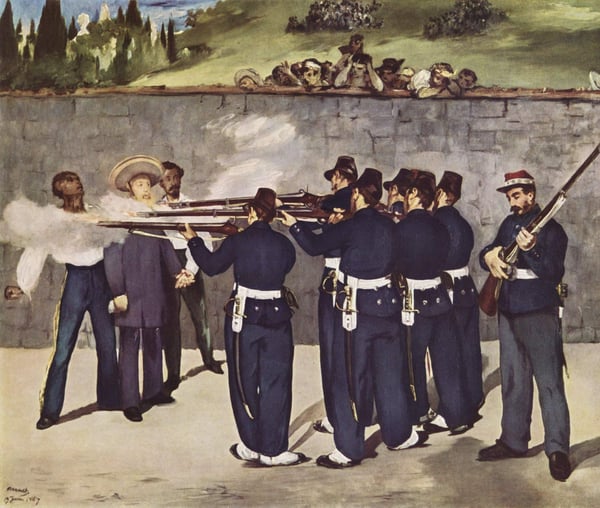
As an expert analysis grounded solely in the provided structured facts, here is the description of "The Execution of the Emperor Maximilian of Mexico" by Edouard Manet, focusing on its significance within the Realism style and history painting genre:
Significance within Realism:
Manet’s work is a landmark of Realism because it applies the movement’s core tenets—unflinching observation, rejection of idealization, and focus on contemporary life—to a major political event. Instead of creating a dramatic, heroic history painting in the traditional academic manner, Manet presents the execution with stark, journalistic detachment. The soldiers are anonymous, the emperor is rendered without saintly grandeur, and the composition feels almost photographic in its flatness. This refusal to moralize or romanticize is what makes the painting a radical statement of Realist principles.
Significance within History Painting:
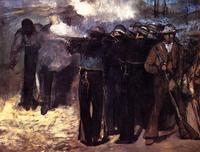
By choosing a recent, scandalous political execution (Maximilian of Mexico was executed in 1867, mere years before Manet painted this version), Manet breaks the convention that history painting must depict ancient or classical subjects. He treats current events with the same seriousness as a biblical or mythological scene, thereby democratizing the genre. His multiple versions of the subject—often suppressed or censored due to diplomatic pressures—also underscore how Realist history painting could serve as direct political commentary, challenging state narratives and confronting viewers with the brutal reality of power.