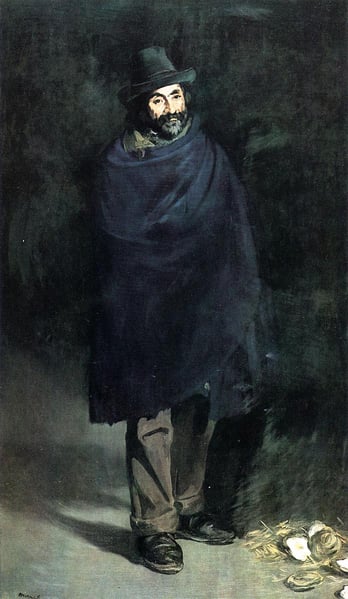
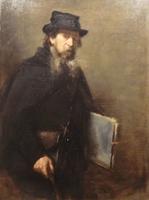
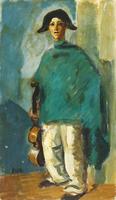
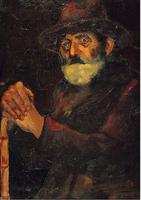
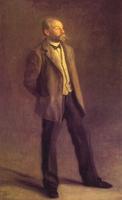
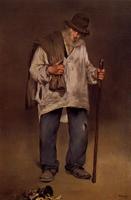
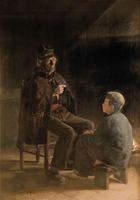
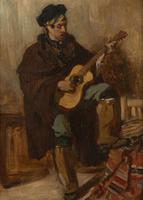
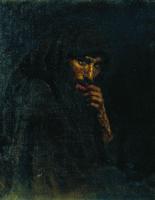
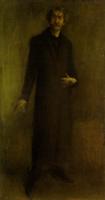
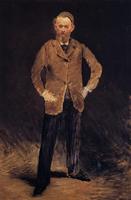
Édouard Manet’s The Philosopher stands as a compelling example of Realist portraiture, a work that pushes against academic conventions by presenting a subject from everyday life with unflinching honesty. As a Realist portrait, its significance lies in Manet’s deliberate choice to depict a solitary, lower-class figure—likely a street beggar or a marginalized thinker—rather than an idealized, heroic, or aristocratic sitter. This aligns with the Realist movement’s core mission: to represent contemporary reality with truth and sincerity, elevating the ordinary to the level of serious art.
The painting’s impact also derives from Manet’s masterful handling of composition and tone. He uses a stark, nearly monochromatic palette and broad, visible brushwork that eschews polished finish, emphasizing the materiality of paint and the raw presence of the subject. The philosopher’s tattered cloak and direct, unidealized gaze confront the viewer with a sense of psychological depth and social commentary. In this way, The Philosopher not only exemplifies Realism’s break from history painting and mythologized themes but also foreshadows Manet’s later influence on Impressionism, marking a pivotal moment in the evolution of modern portraiture.