
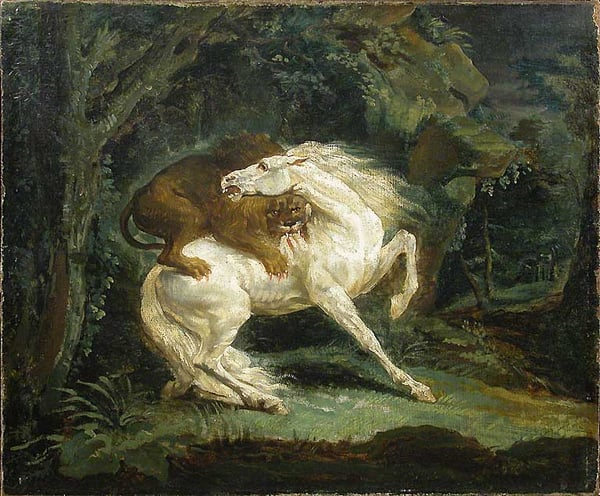
Expert analysis of Théodore Géricault’s Horse attacked by a lion
Style: Romanticism · Genre: animal painting
Expert Analysis: "Horse Attacked by a Lion" by Théodore Géricault
Théodore Géricault’s Horse Attacked by a Lion stands as a quintessential example of Romanticism’s embrace of raw emotion, dynamic movement, and the sublime power of nature. Though classified as an animal painting, this work transcends mere naturalistic depiction to become a visceral exploration of struggle, mortality, and the untamed forces that Romantic artists prized.
Significance within Romanticism:
Géricault rejects the calm, idealized order of Neoclassical animal scenes. Instead, he plunges the viewer into a life-or-death confrontation. The horse rears in a frantic, spiraling motion, its eyes wide with terror, while the lion clings to its flank with predatory ferocity. The composition is off-balance, diagonal, and tightly cropped—a hallmark of Romantic drama that pulls the observer into the chaos. The handling of paint is loose and expressive, with heavy chiaroscuro and thick impasto heightening the sense of immediacy and emotional intensity.
Romantic fascination with the sublime and the irrational:
The painting embodies the Romantic belief that nature—especially in its most violent, destructive forms—reveals profound truths about the human condition. The horse, often a symbol of nobility and civilization (as in Romantic-era equestrian portraits), here becomes a victim of instinctual, brute force. The lion represents the untamable wild, a force beyond rational control. This tension between the tamed and the savage mirrors Géricault’s own preoccupation with suffering, madness, and death, themes that culminate in his masterpiece The Raft of the Medusa.
Artistic innovation in animal painting:
Géricault was a keen anatomist who studied horses and predators at the Paris slaughterhouses and the Jardin des Plantes. His Horse Attacked by a Lion reflects this rigorous anatomical observation—the straining tendons, the gaping jaws, the frenzied musculature—yet it never succumbs to mere reportage. Instead, it elevates animal painting to a vehicle for existential drama. The work directly influenced later Romantic artists, notably Eugène Delacroix, who would similarly use animal violence (as in Lion Hunt) to explore passion and energy.
Legacy:
This painting represents a pivotal moment when animal painting shed its decorative or moralizing function (as in George Stubbs’s serene stable scenes) and became a platform for Romantic Sublime. Géricault’s untamed, emotionally charged treatment of the subject helped redefine the genre, proving that even a “lowly” animal scene could convey the same intensity as a history painting. Today, Horse Attacked by a Lion remains a vivid testament to Romanticism’s core belief: that truth and beauty are found not in order, but in the raw, the violent, and the uncontrollable.
Visually similar
20 works with related composition and palette
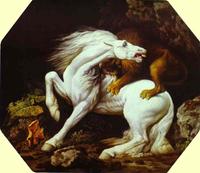
Horse Attacked by a Lion
George Stubbs
Lion Attacking a Horse
George Stubbs
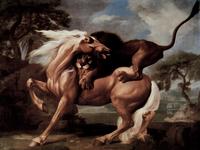
Horse Attacked by a Lion
George Stubbs
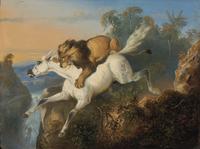
Lion attacking a horse
Raden Saleh
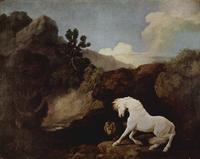
A Horse Frightened by a Lion
George Stubbs
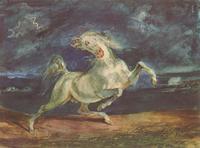
Horse Frightened by a Storm
Eugene Delacroix
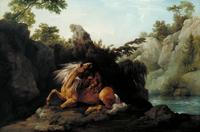
Horse Devoured by a Lion
George Stubbs
Fighting Horses
James Ward
The Moment
James Ward
Mazeppa Surrounded by Horses (after Horace Vernet)
John Frederick Herring Sr.
Mazeppa
Horace Vernet
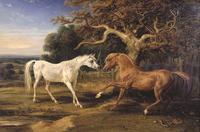
L'Amour de Cheval
James Ward
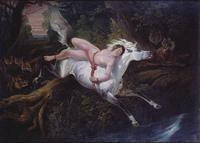
Mazeppa Pursued by Wolves (after Horace Vernet)
John Frederick Herring Sr.
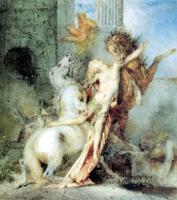
Diomedes Devoured by his Horses
Gustave Moreau
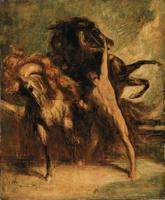
Esquisse pour Automédon avec les chevaux d'Achille
Henri Regnault
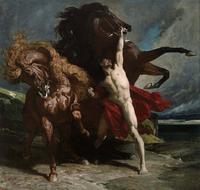
Automedon with the Horses of Achilles
Henri Regnault
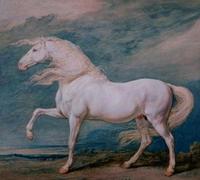
Adonis, a White Stallion
James Ward
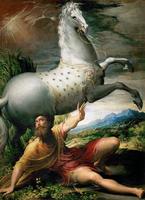
The Conversion Of St Paul
Parmigianino
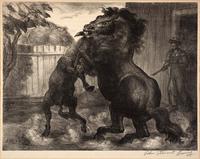
Stallion and Jack Fighting
John Steuart Curry

Horses Frightened by the Storm
Carle Vernet