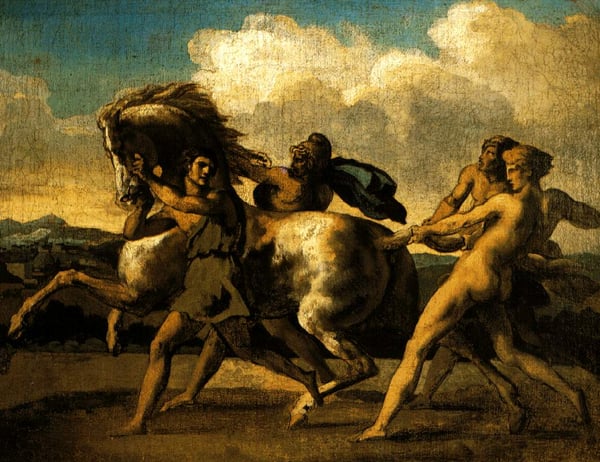
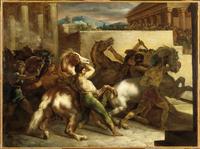
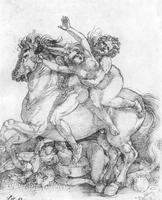
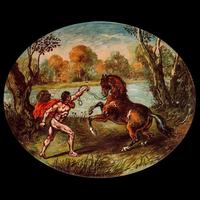
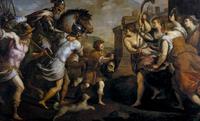
This study by Théodore Géricault, Slaves stopping a horse, is a preparatory work for his ambitious lithograph series The Race of the Barbarian Horses. As a sketch and study within the Romantic movement, its significance lies in capturing raw energy, emotional intensity, and the artist’s process of translating dramatic narrative into form.
Géricault was a master of dynamic composition, and even in this unfinished state, the image conveys violent motion and human struggle. The slaves’ effort to restrain a powerful horse epitomizes the Romantic fascination with the sublime—the tension between human will and untamed nature. The rough, spontaneous handling of line and shadow in this study reveals Géricault’s focus on anatomy and movement, key concerns for Romantic artists who valued expressive, naturalistic energy over classical idealization.
Moreover, the subject matter—exotic, dramatic, and charged with social implications (slavery and domination)—reflects Romanticism’s turn toward contemporary issues and emotionally charged themes. This study is significant not merely as a preparatory sketch, but as a window into Géricault’s creative process, showing how he distilled the violent climax of an entire race into a single, explosive instant of halted motion. It exemplifies the Romantic preference for the fleeting, the powerful, and the psychologically intense, making it a vital document of the period’s artistic ambitions.