
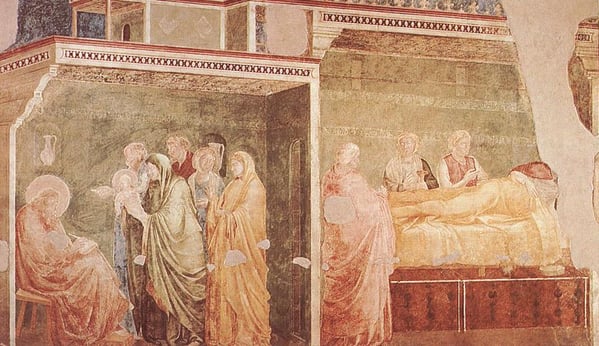
Expert analysis of Giotto’s The Birth of St. John the Baptist and his father Zacharias writing his name
Style: Proto Renaissance · Genre: religious painting
Analysis of "The Birth of St. John the Baptist and his father Zacharias writing his name" by Giotto
This work is a defining example of Giotto’s groundbreaking role in the Proto-Renaissance, a period that bridged the flat, symbolic traditions of Byzantine art with the emerging naturalism of the early Renaissance. As a religious painting, it illustrates a biblical narrative with an unprecedented sense of human drama and spatial clarity.
Significance within Style and Period:
-
Narrative Innovation – Giotto masterfully condenses two sequential moments—the birth of John the Baptist and the writing of his name by his father Zacharias—into a single, coherent scene. This blending of time and action was revolutionary for its day, moving away from static, hieratic compositions toward storytelling that feels immediate and engaging.
-
Naturalism and Emotional Depth – Unlike the rigid, gold-background figures of medieval art, Giotto places his characters in a convincing, shallow interior space. The figures possess weight and volume, their gestures and gazes conveying real emotion: the tenderness of the mother, the absorbed concentration of Zacharias, the quiet curiosity of the attendants. This humanization of sacred subjects was a hallmark of Giotto’s style and a key Proto-Renaissance achievement.
-
Spatial and Pictorial Logic – The architecture of the room—with its simple perspective, draped cloth, and framing elements—creates a stage-like setting that grounds the holy event in a believable world. Giotto uses light and shadow to model forms, lending them three-dimensionality. This attention to pictorial depth and physical presence directly anticipates the Renaissance’s systematic use of perspective.
-
Proto-Renaissance Role – Giotto is often called the “father of Western painting” because he broke decisively from the medieval tradition. In this work, the focus on individual characterization and narrative clarity—rather than symbolic abstraction—marks a turning point. The painting does not just depict a miracle; it invites the viewer into a moment of human connection, establishing a new standard for devotional and narrative art that would influence generations of Renaissance masters such as Masaccio and Leonardo.
In sum, this artwork is significant as a testament to Giotto’s ability to infuse a traditional religious subject with psychological realism, spatial coherence, and storytelling power—hallmarks of the Proto-Renaissance that set the stage for the full flowering of the Italian Renaissance.
Museum / Gallery
Visually similar
20 works with related composition and palette
Isaac Blessing Jacob
Giotto
Trial by Fire of St. Francis of Assisi before the Sultan of Egypt
Giotto
Scenes of Monastic Life
Paolo Uccello
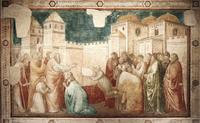
Raising of Drusiana
Giotto
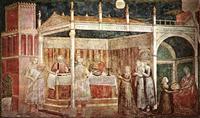
Feast of Herod
Giotto
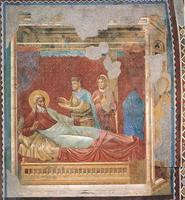
Isaac Rejecting Esau
Giotto
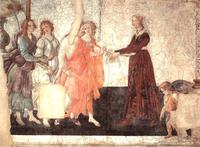
Venus and the Graces offering gifts to a young girl
Sandro Botticelli
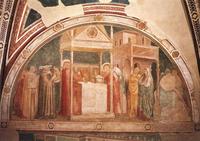
Annunciation to Zacharias
Giotto
The Vintage and Drunkenness of Noah
Benozzo Gozzoli
Scene of peace offerings, Noah's drunkenness and shame
Paolo Uccello
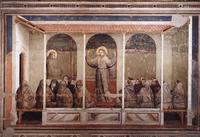
St. Francis Appears to St. Anthony in Arles
Giotto
Annunciation
Sandro Botticelli
Adoration of the Child
Paolo Uccello
Scenes of Monastic Life
Paolo Uccello
The Death of St. Francis
Giotto
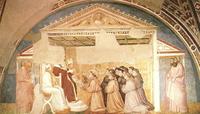
Confirmation of the Rule
Giotto
Church of San Lorenzo (San Giovanni Valdarno), Toscana, Italy
Lo Scheggia
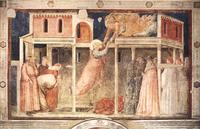
Ascension of the Evangelist
Giotto
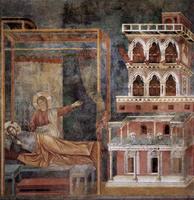
Dream of the Palace
Giotto
Tabernacle of the Visitation: Annunciation: Mary
Benozzo Gozzoli