
Expertenanalyse zu Michelangelos Madonna and Child
Stil: High Renaissance · Genre: sculpture
Expert Analysis: "Madonna and Child" by Michelangelo (High Renaissance Sculpture)
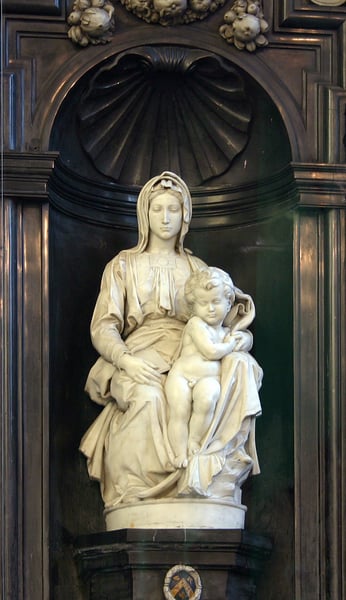
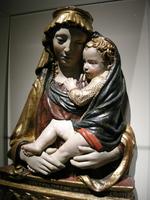
Michelangelo’s Madonna and Child (often identified with the Bruges Madonna, c. 1501–1504) stands as a quintessential achievement of High Renaissance sculpture, embodying the era’s synthesis of classical idealism, anatomical mastery, and profound psychological depth. Carved from luminous Carrara marble, the work transcends the traditional devotional icon by imbuing the figures with a monumental monumentality and a tender, introspective humanity that was revolutionary for its time.
Significance within the High Renaissance
The High Renaissance (c. 1490–1520) prized disegno (design and intellectual clarity), grazia (grace), and the seamless integration of form and emotion. In this sculpture, Michelangelo achieves all three.
- Composition and Pyramidal Structure: The figures are arranged in a stable, pyramidal composition—a hallmark of High Renaissance balance. The Virgin’s robust, seated form provides a solid base, while the Christ Child stands on her knee, turning outward as if to bless the viewer. This triangular geometry, reminiscent of Leonardo’s works, creates a sense of harmonious order while allowing dynamic movement.
- Contrapposto and Naturalism: The Child twists his torso in a subtle contrapposto (weight shift), a pose borrowed from classical antiquity but animated here with toddler-like spontaneity. Mary’s left hand rests on her hip, her body slightly turned, suggesting both maternal protectiveness and contemplative stillness. Michelangelo’s deep knowledge of human anatomy—gained from dissections—enables him to render muscle, bone, and skin with unprecedented verisimilitude, yet he idealizes these forms to convey divine perfection.
- Psychological Depth: Unlike many earlier Madonna images that emphasized hierarchical distance, Michelangelo presents a moment of intimate exchange. The Virgin does not smile; her downward gaze is solemn, as if foreseeing her son’s Passion. The Child, though robust and alert, has a serious expression. This emotional ambiguity—joy colored by foreknowledge—reflects the High Renaissance interest in exploring inner life through outward gesture, a concept Michelangelo had refined in works like the Pietà.
- Treatment of Marble: The surface is polished to a soft, almost skin-like sheen, while the drapery falls in deep, weighty folds that recall antique Roman sculpture. The contrast between smooth flesh and textured cloth demonstrates Michelangelo’s unparalleled ability to suggest different materials in stone.
Art-Historical Context
This piece was likely intended for the Piccolomini altar in Siena but was instead purchased for the Church of Our Lady in Bruges (where it remains). Its placement in Northern Europe spread Italian High Renaissance ideals abroad. The sculpture’s non-finito (unfinished) sections—such as the rough base—foreshadow Michelangelo’s later style, where leaving stone partially rough became a means to express spiritual struggle.
Why It Matters
The Bruges Madonna and Child is significant because it redefines the sacred as human. Where Gothic Madonnas were ethereal and late Quattrocento ones often sentimental, Michelangelo’s version presents a Virgin who is physically powerful, intellectually lucid, and emotionally complex. The work crystallizes the High Renaissance belief that divine beauty is best expressed through perfected nature—and that the most profound spirituality emerges from the most acute observation of the physical world.
Museum / Gallery
Visuell ähnlich
20 Werke mit ähnlicher Komposition und Farbpalette
St. Bibiana
Gian Lorenzo Bernini
Madonna and Child
Zinaida Serebriakova
Madonna and Child
Elisabetta Sirani
Medici Madonna
Michelangelo
Duomo (lucca) - Interior
Giambologna
Saint Jerome
Gian Lorenzo Bernini
Tomb of Pope Alexander VII
Gian Lorenzo Bernini
Habakkuk and the Angel
Gian Lorenzo Bernini
Tomb of Pope Urban VIII
Gian Lorenzo Bernini
Saint Moses
Antonio Corradini
Madonna with Child
Filippo Brunelleschi
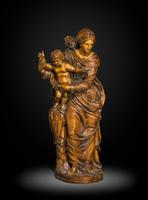
Maria mit Kind
Thomas Blanchet
Saint John the Evangelist
Alessandro Vittoria
The Virgin of Pain
Alessandro Vittoria
After the Battle
Joseph Urbania
Virgin with the Blessing Child
Rogier van der Weyden
The Virgin and Child
Mabuse
Portaombra
Nicola Samorì
Charity Tomb of Urban VIII
Gian Lorenzo Bernini
Madonna with Child
Filippo Brunelleschi