The Conversion of Saul
Details
Expert analysis of Michelangelo’s The Conversion of Saul
Style: Mannerism (Late Renaissance) · Genre: religious painting
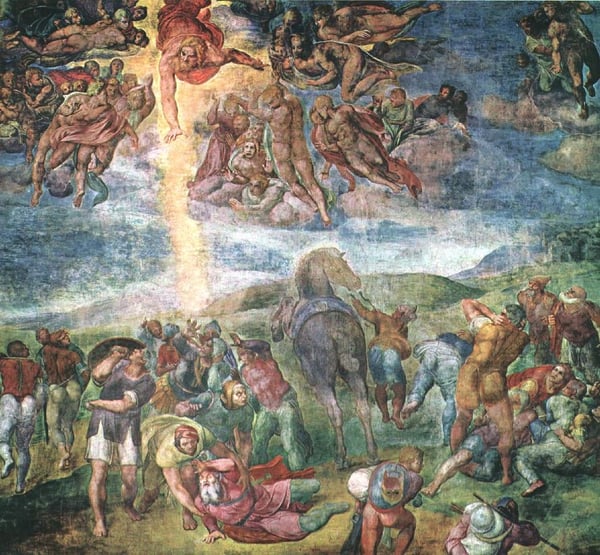
An expert analysis of Michelangelo's The Conversion of Saul (fresco in the Cappella Paolina, Vatican) reveals its significance as a culminating masterpiece of Mannerism. Painted late in Michelangelo's career (1542–1545), this religious scene exemplifies the Mannerist break from High Renaissance balance through its jarring composition, spiritual intensity, and distorted figural proportions.
Significance within Mannerism:
- Dynamic instability: Saul’s dramatic fall, blinded by divine light, creates a spiraling, off-balance composition. The figures twist and contort, rejecting the stable pyramid structures of Michelangelo's earlier works (e.g., the Sistine Chapel). This embodies Mannerism’s deliberate awkwardness to convey spiritual upheaval.
- Elongated, serpentine forms: Christ’s swooping, almost weightless body and Saul’s sprawling limbs exemplify the figura serpentinata—a hallmark Mannerist device that prioritizes elegant, complex poses over naturalism.
- Crowded, disorienting space: The foreground is packed with fleeing soldiers and a horse that rears and curves, compressing depth. This claustrophobic, irrational space differs sharply from the clear perspective of the Renaissance, serving to heighten the miraculous moment’s psychological chaos.
- Heightened emotional and spiritual tension: Michelangelo abandons narrative clarity for raw, visionary drama. Saul’s face is a mask of shock and humility; the light that strikes him is violently directional, creating stark chiaroscuro that prefigures Baroque intensity.
Art-historical weight: As Michelangelo’s last major fresco (alongside The Crucifixion of St. Peter in the same chapel), The Conversion of Saul marks his final, restless phase. It subverts his own celebrated High Renaissance style to explore Mannerism’s expressive potential—prioritizing subjective emotion and spiritual crisis over formal harmony. This work thus stands as a bridge between the idealism of the Renaissance and the heightened drama of the Baroque, demonstrating Michelangelo’s enduring capacity for innovation.
Museum / Gallery
Visually similar
20 works with related composition and palette
Die Hunnenschlacht
Wilhelm von Kaulbach
Martyrdom of St.Peter
Michelangelo
Universal judgment
Noè Bordignon
The Abduction of Bulls
Peter Paul Rubens
The Last Judgement
Jan Brueghel the Elder
l'inferno di dante
Joseph Anton Koch
Submission of Frederick Barbarossa before Pope Alexander III during the signing of the Treaty of Venice (detail)
Francesco de' Rossi (Francesco Salviati), "Cecchino"
Sistine Chapel Ceiling: The Brazen Serpent
Michelangelo
The Brazen Serpent
Tintoretto
Last Judgment
Willem van Swanenburg
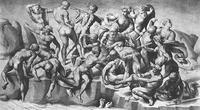
Battle of Cascina (Copy by Michelangelo's pupil Aristotele da Sangallo)
Michelangelo
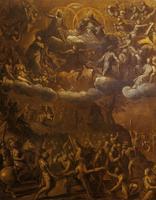
The Crucifixion of St Peter
Palma il Giovane
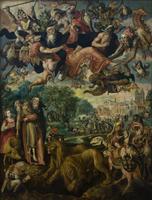
The Temptation of Saint Anthony
Maarten de Vos
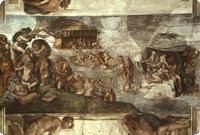
Sistine Chapel Ceiling: The Flood
Michelangelo
The Temptations of Antony Abbot of Egypt
Maarten de Vos
The Deaths of Saul and Jonathan
Francesco de' Rossi (Francesco Salviati), "Cecchino"
Juicio Final
Maarten de Vos
The Israelites crossing the Red Sea
Agnolo Bronzino
The Fight between the Lapiths and the Centaurs
Piero di Cosimo
Sketch for Paradise (to decorate the room of the Grand Council of the ducal palace of Venice)
Paolo Veronese