The Prophet Jonah
Details
Expert analysis of Michelangelo’s The Prophet Jonah
Style: High Renaissance · Genre: religious painting
Expert Analysis: "The Prophet Jonah" by Michelangelo
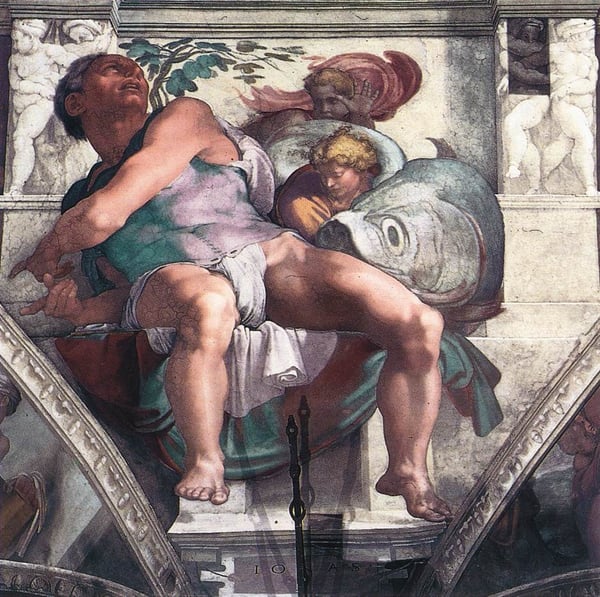
As a High Renaissance religious painting, Michelangelo’s "The Prophet Jonah" (c. 1508–1512) is a pivotal figure within the Sistine Chapel ceiling frescoes. Its significance lies in Michelangelo’s revolutionary use of foreshortening, dynamic anatomy, and theological symbolism, which together elevate the prophet beyond mere biblical illustration to a masterful statement of human and divine drama.
1. Monumental Foreshortening and Spatial Illusion
Jonah is depicted twisting backward, his torso and legs sharply foreshortened as he gazes upward toward God. This daring perspective—unprecedented in its complexity at the time—creates a powerful illusion of three-dimensionality. The figure appears to burst out of the painted architectural frame, engaging the viewer from below. Michelangelo’s mastery of di sotto in sù (view from below) here anticipates Baroque illusionism, making Jonah a landmark in spatial representation.
2. Anatomical Virtuosity and Contraposto
Jonah’s muscular body is rendered with Michelangelo’s signature terribilità—a charged, coiled energy. The contorted pose (a twisting contrapposto) reflects the tension of Jonah’s narrative: his reluctant prophecy, his flight, and his ultimate submission to God’s will. The exaggerated musculature, especially the dramatic twist of the shoulders against the hips, demonstrates Michelangelo’s deep study of human anatomy and his ability to convey psychological strain through physical form.
3. Theological Depth and Typological Significance
In Christian typology, Jonah’s three days in the whale prefigure Christ’s resurrection. Michelangelo emphasizes this by placing Jonah directly above the altar, near the separation of the ceiling’s narrative panels. The prophet’s upward gaze and open mouth—as if in mid-speech or awe—capture the moment of divine revelation. This positioning makes Jonah the spiritual anchor of the entire ceiling, linking Old Testament prophecy to New Testament salvation.
4. Contrast and Compositional Role
Among the twelve prophets and sibyls flanking the central creation scenes, Jonah stands out for his dramatic asymmetry. His figure is not static but in motion, breaking the rhythmic symmetry of the other figures. The stark white of his hair and loincloth contrasts with the deep blue background, drawing the eye immediately. This deliberate disruption of balance reflects Michelangelo’s High Renaissance desire to infuse classical harmony with intense emotional expression.
Conclusion
“The Prophet Jonah” is significant as a technical tour de force that redefined foreshortening, a theological linchpin of the Sistine Chapel’s iconographic program, and a vivid example of Michelangelo’s ability to merge physical realism with spiritual transcendence. It remains a cornerstone of High Renaissance art, influencing generations of painters with its audacious perspective and sculptural vitality.
Museum / Gallery
Visually similar
20 works with related composition and palette
The Prophet Daniel
Michelangelo
Frescoes above the altwall
Michelangelo
Sistine Chapel Ceiling: Libyan Sibyl
Michelangelo
The Prophet Isaiah
Michelangelo
Sistine Chapel Ceiling: The Delphic Sibyl
Michelangelo
Ceiling Of The Sistine Chapel. Sybils Erithraea
Michelangelo
Sistine Chapel Ceiling: The Prophet Joel
Michelangelo
The Ancestors of Christ: Asa
Michelangelo
The Prophet Jeremiah
Michelangelo
Sistine Chapel Ceiling: Cumaean Sibyl
Michelangelo
Sistine Chapel Ceiling: The Persian Sibyl
Michelangelo
The Prophet Ezekiel
Michelangelo
Sistine Chapel Ceiling: God Dividing Land and Water
Michelangelo
Frescoes above the entrance wall
Michelangelo
The Ancestors of Christ: Salmon
Michelangelo
Sistine Chapel Ceiling
Michelangelo
Sistine Chapel Ceiling: God Dividing Land and Water
Michelangelo
Sistine Chapel Ceiling: Creation of Eve
Michelangelo
Sistine Chapel Ceiling: Creation of Adam
Michelangelo
The Creation of Adam
Michelangelo