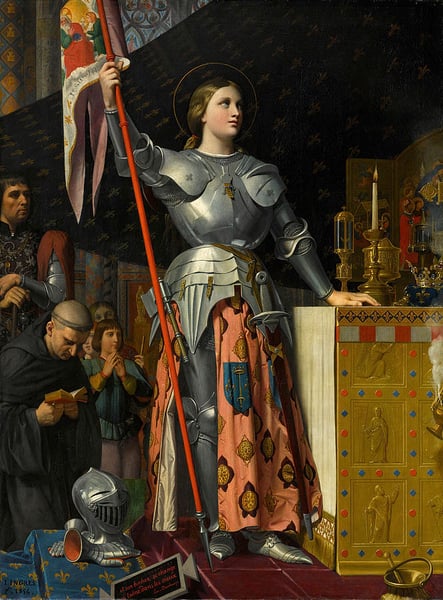
Jean Auguste Dominique Ingres’s Joan of Arc at the Coronation of Charles VII in the Cathedral of Reims (1854) is a quintessential Neoclassical history painting that reaffirms the style’s core principles—clarity of line, idealized form, and moral gravitas—while also showcasing Ingres’s masterful synthesis of historical narrative and spiritual transcendence. As a history painting, it elevates a pivotal moment in French national myth: Joan’s presence at Charles VII’s coronation, a triumph of divine will over political turmoil. Ingres renders the scene with the Neoclassical hallmarks of precise draftsmanship, balanced composition, and a polished surface that eschews overt emotion in favor of restrained grandeur.
What makes this work particularly significant within Neoclassicism is its fusion of archaeological accuracy (note the cathedral’s architecture and period costumes) with an almost icon-like, hieratic treatment of Joan. She is depicted not in the heat of battle but in a moment of quiet, visionary authority—standing apart from the courtly crowd, her armor gleaming, her gaze fixed heavenward as an angel hovers above. This compositional choice underscores Neoclassicism’s emphasis on virtue and duty over dramatic action. Ingres, ever the advocate of “pure drawing,” uses taut, flowing contours to define Joan’s figure, celebrating her as both a historical heroine and a quasi-saintly allegory of French unity. The painting’s restrained palette of blues, golds, and whites reinforces its solemn dignity, while the meticulous rendering of cloth, metal, and stone demonstrates Ingres’s technical precision.
In the context of Ingres’s oeuvre and the 19th-century revival of national history, the work stands as a deliberate counterpoint to Romanticism’s turbulent energy. Instead, it offers a Neoclassical ideal of stillness and moral clarity—a vision of divine ordination channeled through human discipline. This painting thus not only exemplifies Ingres’s lifelong commitment to the intellectual and formal rigor of his style but also represents a high point in the Neoclassical ambition to educate and inspire through the art of history.