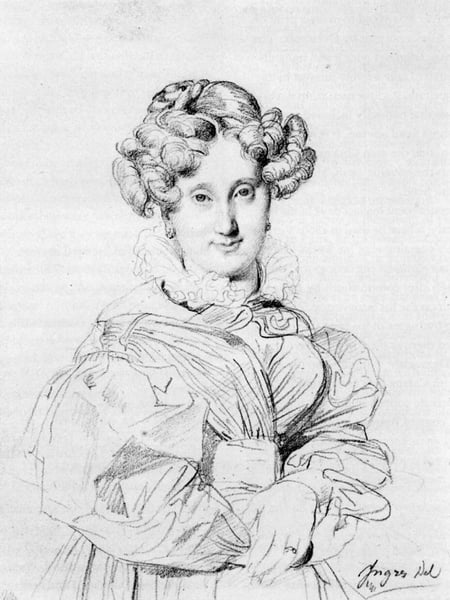
Madame Louis François Godinot, born Victoire Pauline Thiolliere de L'Isle
Analisi esperta di Madame Louis François Godinot, born Victoire Pauline Thiolliere de L'Isle di Jean Auguste Dominique Ingres
Stile: Neoclassicism · Genere: portrait
Expert Analysis of Madame Louis François Godinot, born Victoire Pauline Thiolliere de L'Isle by Jean Auguste Dominique Ingres
As a portrait by the master Neoclassicist Jean Auguste Dominique Ingres, this work stands as a refined embodiment of the stylistic and philosophical ideals that define the Neoclassical period. Its significance lies in how Ingres seamlessly merges the strict formal discipline of the style—clarity of line, balanced composition, and classical restraint—with the intimate, individualized demands of portrait painting.
Executing Neoclassical Ideals through Portraiture
Ingres, a leading figure of the Neoclassical movement, consistently prioritized line and form over color. In this portrait, the subject’s posture, the arrangement of her costume, and the precise rendering of her features would have been executed with the linear precision that sets his work apart. The genre of portraiture allowed Ingres to apply Neoclassicism’s veneration for order and idealized human form to a specific, living individual, elevating the sitter to a timeless, almost emblematic status without sacrificing her identity.
Psychological Depth within a Classical Framework
What makes the portrait significant is Ingres’ ability to convey the sitter’s social station and inner composure through a language of muted elegance. The very title—Madame Louis François Godinot, born Victoire Pauline Thiolliere de L'Isle—suggests a woman of status, and Ingres would have captured her dignity through a calm, direct gaze and a harmonious arrangement of aristocratic attire. The composition likely avoids dramatic effects or excessive ornament, relying instead on the purity of silhouette and the subtle interplay of textures, hallmarks of Ingres’ mature work.
Contribution to Neoclassical Portraiture
Within the Neoclassical period, Ingres’ portraits are often considered the apex of the style’s application to human subjects. This work exemplifies his signature approach: an almost sculptural stillness, a respect for the sitter’s individuality regulated by the universal principles of harmony and reason. By anchoring a specific person in the timeless aesthetic of antiquity, Ingres created a portrait that is both a precise historical record and a lasting statement of Neoclassical ideals. The painting thus serves as a key example of how the movement could achieve intimacy without sacrificing its core commitment to order, clarity, and idealized beauty.
Museum / Gallery
Visivamente simili
20 opere con composizione e palette affini
Portrait of Helena Fourment
Peter Paul Rubens
Madame Desire Raoul Rochette
Jean Auguste Dominique Ingres
Sketch-Portrait of Charlotte Emden Moscheles (15 August 1837)
Henri Lehmann
Mademoiselle Cecile Panckoucke
Jean Auguste Dominique Ingres
Portrait of miss Bonnard
Jean Auguste Dominique Ingres
Madame Jean Auguste Dominique Ingres, born Madeleine Chapelle
Jean Auguste Dominique Ingres
Madame Louis-Francois Bertin
Jean Auguste Dominique Ingres
Spanish Opera Singer María Manuela Oreiro Lema
Rosario Weiss Zorrilla
Madame Franz Adolf von Stuerler, born Matilda Jarman
Jean Auguste Dominique Ingres
Madame Charles Gounod, born Anna Zimmermann
Jean Auguste Dominique Ingres
Lady William Henry Cavendish Bentinck, born Lady Mary Acheson I
Jean Auguste Dominique Ingres
Madame Charles Simart, born Amélie Baltard
Jean Auguste Dominique Ingres
Margaret (née Brooke), Lady Denham
Charles Turner
Portrait of Anna Olenina
Orest Kiprensky
Maria Kriehuber (Born Forstner), Kriehuber's Wife
Josef Kriehuber
Madame Jean Auguste Dominique Ingres, born Delphine Ramel
Jean Auguste Dominique Ingres
The artist's wife
Johann Nepomuk Passini
Portret Van Aertge Witsen
David Bailly
Self Portrait
Rosario Weiss Zorrilla
Frances Teresa Stuart, Duchess of Richmond and Lennox
Charles Turner