Jean Auguste Dominique Ingres sanatçısının Portrait of a Man, possible Edmé Bochet eseri hakkında uzman analizi
Tarz: Neoclassicism · Tür: portrait
Expert Art Historical Analysis: "Portrait of a Man, possible Edmé Bochet" by Jean Auguste Dominique Ingres
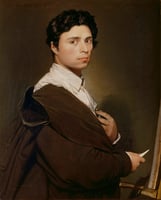
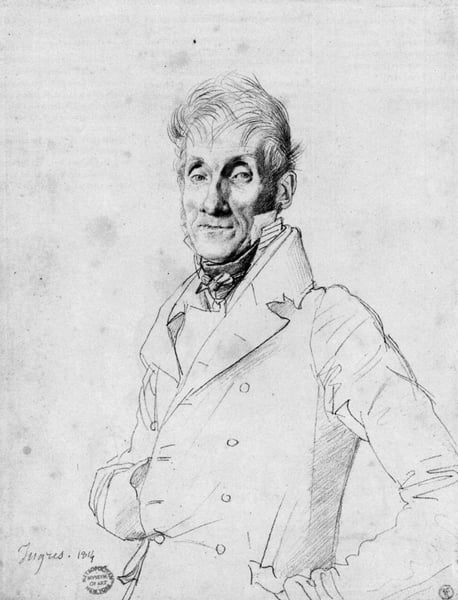
This work exemplifies Ingres’s mastery within Neoclassicism, a style that prized clarity, order, and idealized form over the emotional excess of Romanticism. Although the sitter’s identity is only tentatively given as Edmé Bochet, the portrait is significant for how it distills the Neoclassical ethos through Ingres’s signature technical precision and psychological restraint.
1. Technical Virtuosity and Ingres’s Signature Line
Ingres was renowned for his impeccable draftsmanship and smooth, enamel-like finish. In this portrait, every contour is rendered with surgical exactness—the crisp outline of the jaw, the subtle modeling of the cheekbones, and the meticulous rendering of the sitter’s attire. The absence of visible brushstrokes creates a cool, polished surface that conforms to Neoclassicism’s reverence for perfect, almost sculptural form. This precision was not mere decoration; it was a moral and aesthetic statement, asserting that art should elevate nature through reason and discipline.
2. Psychological Dignity and Neoclassical Restraint
Unlike Romantic portraits that often dramatize inner turmoil, Ingres presents a man of quiet composure. The sitter’s gaze is direct but unflinching, his expression neutral yet subtly commanding. This restraint aligns with Neoclassicism’s ideal of the virtuous, rational individual—a modern embodiment of ancient Roman gravitas. The dark, subdued palette and spare background focus all attention on the face, suggesting that true character resides in intellectual and moral substance rather than fleeting emotion.
3. Tension Between Realism and Idealization
Ingres balanced acute likeness with idealized refinement. While the specific features (the shape of the nose, the slight asymmetry of the mouth) suggest a real individual, the overall effect is one of timeless dignity. This tension—between the particular and the universal—is a hallmark of Ingres’s portraiture and a key contribution to Neoclassical practice. The painting does not merely record a face; it constructs an archetype of the enlightened, self-possessed citizen of the post-Revolutionary era.
Significance within Ingres’s Oeuvre and Neoclassicism
This portrait occupies a crucial place in Ingres’s career, when he was solidifying his reputation as the foremost Neoclassical portraitist after David. It demonstrates his ability to infuse a conventional genre with intellectual gravity and formal perfection. For Neoclassicism, the work reaffirms the style’s core belief that art should instruct through clarity, order, and the celebration of human reason—all while never sacrificing the subtle individuality that distinguishes a living person from a mere ideal.
Museum / Gallery
Görsel olarak benzer
İlişkili kompozisyon ve renk paletine sahip 20 eser
Portrait of young man
Orest Kiprensky
Dr. Thomas Church
Jean Auguste Dominique Ingres
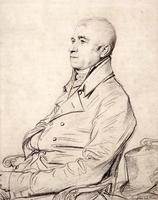
The Reverend Joseph Church
Jean Auguste Dominique Ingres
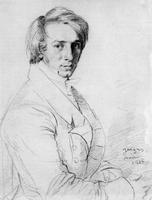
Ursin Jules Vatinelle
Jean Auguste Dominique Ingres
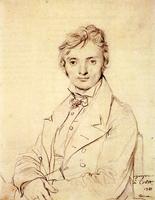
Jean Pierre Cortot
Jean Auguste Dominique Ingres
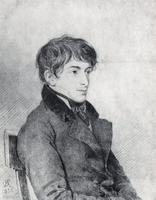
Portrait of Nikita Mikhailovich Muraviev
Orest Kiprensky
Portrait of Mr. Foureau
Jean Auguste Dominique Ingres
Portrait of a Man
Jean Auguste Dominique Ingres
Self Portrait
Jean Auguste Dominique Ingres
Alexis Rene Le Go
Jean Auguste Dominique Ingres
Portrait of Jean-Victor Schnetz
Jules Dupre
Portrait of Theodor Pelissier (1794–1863) from Hanau
Leopold Pollak
Otto Magnus von Stackelberg and Jacob Linckh
Jean Auguste Dominique Ingres
Portrait of Ferdinand Flor
Leopold Pollak
Robert C. Sands
Asher Brown Durand
Karl Josef Lipinsky, Polish music composer and virtuoso violinist
Josef Kriehuber
Adolphe Goupil, prints editor
Achille Devéria
Dr. François Melier
Jean Auguste Dominique Ingres
Portrait of Franz Xaver Winterhalter
Leopold Pollak
Karl Artaria, Viennese Art Dealer
Alexander Clarot