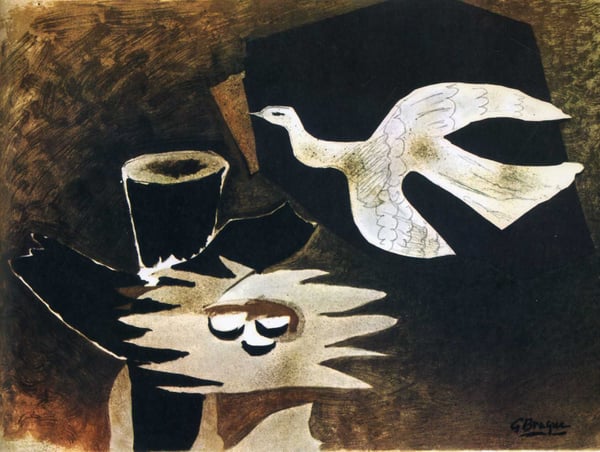
Bird Returning to Its Nest
Dettagli
Analisi esperta di Bird Returning to Its Nest di Georges Braque
Stile: Cubism, Expressionism · Genere: animal painting
Analysis of "Bird Returning to Its Nest" by Georges Braque
Style: Cubism, Expressionism | Genre: Animal Painting
Georges Braque, co-founder of Cubism alongside Pablo Picasso, is celebrated for transforming the way we perceive space, form, and perspective. His painting "Bird Returning to Its Nest" holds particular significance as a late-career work that bridges the analytical rigor of Cubism with the emotional resonance of Expressionism—a synthesis that reveals Braque’s enduring drive to push the boundaries of modern art.
Cubist Foundations
True to Braque’s Cubist roots, the painting dismantles the subject—a bird in flight toward its nest—into a constellation of geometric planes and interlocking facets. Instead of depicting the bird with naturalistic detail, Braque uses fractured lines, layered contours, and muted, earthy tones (ocher, gray, blue-green) to suggest both motion and stasis. The nest, a symbol of home and return, is deconstructed into angular, almost architectural forms, echoing the artist’s earlier "house" and "still life" motifs. This fragmentation does not destroy the image but invites the viewer to reconstruct the bird’s trajectory through space, a hallmark of Cubist simultaneity.
Expressionist Infusion
What distinguishes this work from Braque’s more austere Cubist canvases is the infusion of Expressionist energy. The brushwork becomes looser, more gestural, and the color palette takes on a surprising warmth. Deep browns and soft whites collide with patches of vivid blue and red, creating a emotional undertone of longing, security, or cyclical return. The bird’s wing, though abstracted, arcs with a lyrical, almost calligraphic force—a departure from the cool geometry of early Cubism. This expressive handling imbues the animal subject with psychological weight, transforming a simple avian homecoming into a meditation on refuge, journey, and the passage of time.
Significance within Braque’s Oeuvre and Art History
"Bird Returning to Its Nest" exemplifies Braque’s later period (post–World War I), when he moved away from the stricter programs of Synthetic Cubism toward a more personal, poetic sensibility. Here, he proves that Cubism need not be cold or cerebral: it can serve an intimate, emotional narrative. The painting also stands out within the animal painting genre, which was less central to Braque than still life. By choosing a bird—an ancient symbol of the soul, freedom, and domestic return—he ties modernist abstraction to timeless themes, demonstrating that Cubist language can express primal human experiences. In this work, Braque achieves what few of his contemporaries could: a perfect fusion of form and feeling, structure and soul, making it a key transitional piece between Cubism’s early radicalism and the lyrical abstraction that would follow.
Museum / Gallery
Visivamente simili
20 opere con composizione e palette affini
Bird and it's nest
Georges Braque
Tree House
Gene Davis
'Koh Chang 1.' - lithography fine print art, 1997; graphic artist Hilly van Eerten
Hilly van Eerten
Coq caraïbe
Wifredo Lam
Birds of a Feather
Pablo Picasso
Wounded bird
Pablo Picasso
A Bird Passing through a Cloud
Georges Braque
Untitled
Grace Pailthorpe
Babits: The book of Jonah II.
Maria Bozoky
Return to the House of the Sun
Françoise Gilot
Objet subjectivité
Victor Brauner
Animaux claniques hominisés
Victor Brauner
Diana in the Autumn Wind
Paul Klee
Stone Bird
Endre Balint
Colére serpentine
Pierre Alechinsky
La Madmoiselle du Jamaica
Enrico Baj
Blue bird pumpkin
Paul Klee
Kô & Kô
Maria Helena Vieira da Silva
Hierarchical Birds
Mark Rothko
Bird Woman
Eileen Agar