Analisi esperta di Still Life on a Table di Georges Braque
Stile: Synthetic Cubism · Genere: still life
Expert Analysis: "Still Life on a Table" by Georges Braque
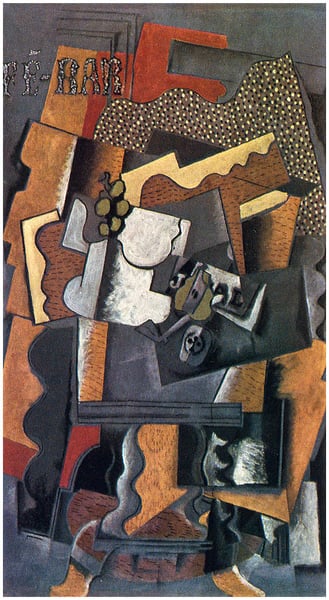
This work stands as a pivotal example of Synthetic Cubism, the later phase of the movement Braque co-founded with Pablo Picasso. Unlike the earlier, monochromatic Analytical Cubism that shattered objects into nearly unrecognizable facets, Synthetic Cubism marks a return to color, clarity, and compositional harmony while retaining the radical reimagining of space.
Significance within the style and period:
- Simplification and Synthesis: Braque abandons the rigorous fragmentation of forms. Instead, he synthesizes objects—a table, a glass, a fruit bowl, a napkin—from a few flat, overlapping planes. The objects are legible but flattened, suggesting multiple viewpoints simultaneously. This directness was a revolutionary departure from the dense, austere works of earlier Cubism.
- Reintroduction of Color and Decoration: The palette is richer and more varied than in Analytical works, with warm ochres, greens, and blacks. The inclusion of decorative elements—like fabric, tablecloth patterns, and the wood grain of the table—shows Braque integrating domestic and tactile beauty without sacrificing the intellectual rigor of spatial play.
- Pioneering Collage Aesthetic: Braque had recently invented the papier collé (pasted paper) technique, and this painting reflects its influence even in oil. The flatness of the painted surfaces mimics cut-out shapes, creating a tension between "real" texture and illusionistic depth. The table itself becomes a tilted, shallow stage where objects float in ambiguous relation to the viewer.
- Still Life as a Core Genre: For Braque, the still life was the ideal laboratory for Cubist inquiry because it allowed complete control over form, composition, and the relationship between objects. Still Life on a Table exemplifies how the genre became a vehicle for probing perception—not of the world, but of the act of seeing itself.
Why it matters: This work demonstrates the transition from Cubism as a method of deconstruction to one of reconstruction. Braque proves that Cubist space can be inviting, decorative, and emotionally resonant without abandoning its radical break with Renaissance perspective. The painting is a cornerstone of the Synthetic style, directly influencing later developments in modern abstraction, collage art, and the use of mixed media.
Museum / Gallery
Genere
Stile
Visivamente simili
20 opere con composizione e palette affini
Still Life with Grapes (II)
Georges Braque
Fruit vase and bunch of grapes
Pablo Picasso
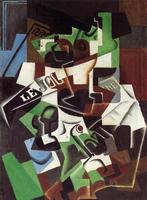
Fruit Bowl, Pipe and Newspaper
Juan Gris
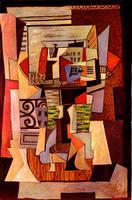
Window opened to the street Penthieure
Pablo Picasso
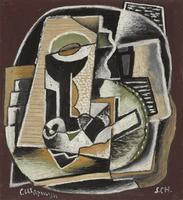
Composition, cubisme ornemental
Serge Charchoune
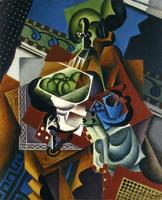
Still Life: Playing Cards, Coffee Cup and Apples
Jean Metzinger
Vanity Box
Kazimir Malevich
The table
Pablo Picasso
Newspaper, Glass and Pear
Juan Gris
Cin-Zin
Karl Knaths
The buffet of 'Catalan'
Pablo Picasso
Bodegón
Maria Blanchard
A Black Pedestal
Georges Braque
Untitled
Pablo Picasso
Guard
Kazimir Malevich
Bodegón
Maria Blanchard
Composición Cubista Con Botella
Maria Blanchard
The lady at the piano
Kazimir Malevich
Untitled
Pablo Picasso
Naturaleza Muerta Con Tijeras
Maria Blanchard