Analisi esperta di The shy man di Francisco Goya
Stile: Romanticism · Genere: caricature
Expert Analysis of "The Shy Man" by Francisco Goya
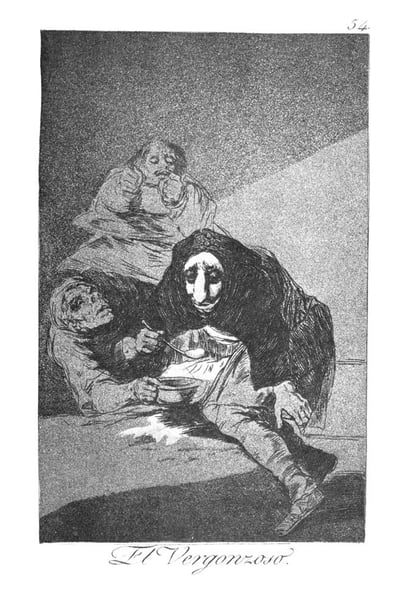
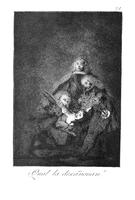
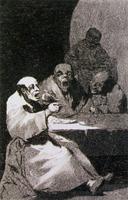
Francisco Goya’s The Shy Man is a striking example of Romantic caricature, a genre in which the artist excelled as a shrewd social commentator. Created within the context of his celebrated series Los Caprichos (1797–1798), this print exemplifies how Goya fused the emotional intensity of Romanticism with the biting satire of caricature to critique the hypocrisies and absurdities of Spanish society.
Significance within Romanticism and Caricature
Goya stands apart from many Romantic contemporaries by turning the lens of caricature away from lighthearted amusement and toward a darker, more psychological examination of human nature. In The Shy Man, the exaggerated features—the hunched posture, the nervously averted gaze, the oversized hat or clothing—serve not merely to provoke laughter but to expose inner timidity as a societal failure or a mask for hidden vices. This aligns with Romanticism’s fascination with the individual’s inner turmoil and the tension between authentic emotion and social performance.
The work is significant for its masterful use of etching and aquatint, techniques Goya employed to create rich tonal contrasts that heighten the dramatic, almost theatrical quality of the scene. The soft shadows and stark highlights emphasize the character’s isolation and vulnerability, lending the caricature a psychological depth rarely seen in earlier satirical prints.
Cultural and Historical Context
Los Caprichos was a radical departure from traditional caricature, which often targeted specific political figures or types with broad humor. Instead, Goya offered a universal critique of human folly—vanity, superstition, cowardice—disguised as a depiction of the “shy man.” The title itself is ironic: the subject’s shyness may be a front for arrogance, ignorance, or even malice, a recurring theme in Goya’s work where outward appearance contradicts inner truth.
As Romanticism championed subjective experience and rebellion against convention, Goya’s caricature embodies that spirit by challenging the viewer to look beneath the surface. The Shy Man thus becomes a mirror held up to society, revealing the discomfort of self-awareness—a hallmark of Goya’s enduring influence on both modern art and the evolution of the caricature as a serious artistic form.
Visivamente simili
20 opere con composizione e palette affini
A Gift for the Master
Francisco Goya
Little goblins
Francisco Goya
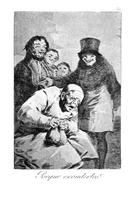
Why hide them?
Francisco Goya
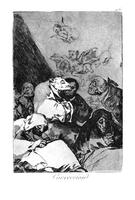
Correction
Francisco Goya
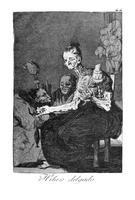
They spin finely
Francisco Goya
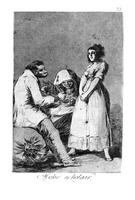
It is better to be idle
Francisco Goya
Be quick, they are waking up
Francisco Goya
Swallow it, dog
Francisco Goya
Don't scream, silly
Francisco Goya
Christ disputing with the doctors
Rembrandt
No one has seen us
Francisco Goya
There is a lot to suck
Francisco Goya
Jesus Disputing with the Doctors
Rembrandt
It is Time
Francisco Goya
How they break her barrel
Francisco Goya
The Drinkers
Adriaen van Ostade
Disordered
Francisco Goya
Absurdity of Carnival
Francisco Goya
They are hot
Francisco Goya
Martyrdom of Felicitas of Tuburbia in Mauretania, AD 201
Jan Luyken