Analisi esperta di The Swing di Francisco Goya
Stile: Romanticism · Genere: genre painting
Expert Analysis of "The Swing" (El columpio) by Francisco Goya
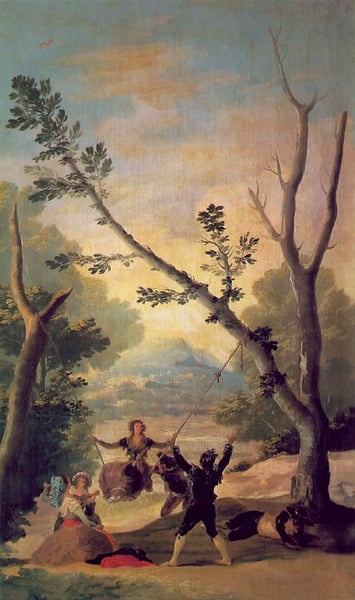
As a genre painting executed within the Romantic sensibility, Goya’s "The Swing" (c. 1787) departs decisively from the Rococo frivolity of its French predecessor (Fragonard’s famous version). Instead, Goya transforms a lighthearted pastime into a nuanced study of human vulnerability and social tension—hallmarks of his early Romantic vision.
Significance within Romanticism:
- Psychological depth: Where Rococo treated the swing as a playful erotic metaphor, Goya infuses the scene with a palpable unease. The figures are not idealized; their expressions and postures suggest a fleeting, precarious moment, emphasizing Romanticism’s fascination with the transient and the emotional.
- Everyday realism: Goya grounds the subject in the daily life of Spanish peasants or middle-class revelers, anticipating Romanticism’s turn toward the authentic experiences of ordinary people rather than aristocratic allegory.
- Dramatic light and shadow: The sharp contrast between the sunlit figures and the darkened background creates a theatrical tension, a device Goya would later perfect in his darker works. This chiaroscuro prefigures the Romantic emphasis on subjective mood and the sublime.
Significance within genre painting:
- Social observation: As a genre painter, Goya treats a common leisure activity not as mere decoration but as a mirror of Spanish society. The swing’s motion implies both freedom and risk, subtly critiquing the instability of pleasure and the fragility of human happiness.
- Narrative ambiguity: Unlike didactic genre scenes, Goya’s composition refuses a clear moral. Is this innocent joy or a cautionary tale? This ambiguity elevates the work from anecdote to a meditation on the human condition, a key achievement of Romantic genre painting.
Overall importance: “The Swing” stands as a transitional work, bridging the decorative charm of the 18th century with the emotional intensity of the Romantic era. Its significance lies in Goya’s ability to invest a simple genre scene with the psychological complexity and social awareness that would define his mature masterpieces. The painting reminds us that Romanticism’s greatest contribution to genre painting was not escapism, but a profound engagement with the real and the unsettling.
Museum / Gallery
Visivamente simili
20 opere con composizione e palette affini
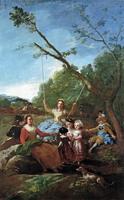
The Swing
Francisco Goya
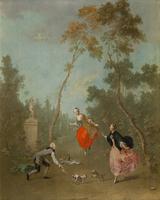
Lady on a Swing
Norbert Joseph Carl Grund

A Wooded Landscape with a Bacchic Scene
Pierre-Henri de Valenciennes
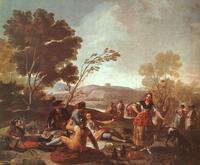
Picnic on the Banks of the Manzanares
Francisco Goya
Latona Turning the Lycians into Frogs
Pieter Brueghel the Younger
Fête Galante
Jean-Baptiste Pater
Ruins and Figures
Paul Bril

Monks Fishing
Salvator Rosa
Fuga de Margarida de Anjou (Episódio da Guerra das Duas Rosas)
Vieira Portuense
Scène de bataille
Adriaen Frans Boudewyns
Pilgrimage on the Isle of Cythera
Antoine Watteau
Saint John the Baptist Revealing Christ to the Disciples
Salvator Rosa
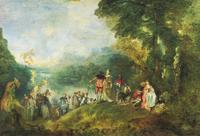
The Embarkation for Cythera
Antoine Watteau
Landscape with Stag Hunt
Paul Bril
Paesaggio boscoso
Alessio de Marchis
Landscape
Jean-Baptiste Morret
The Halt during the Chase
Antoine Watteau
Landscape with Flight into Egypt
Claude Lorrain
Three Sons of the Earl of Bute
Johan Zoffany
The Dance
Jean-Baptiste Pater