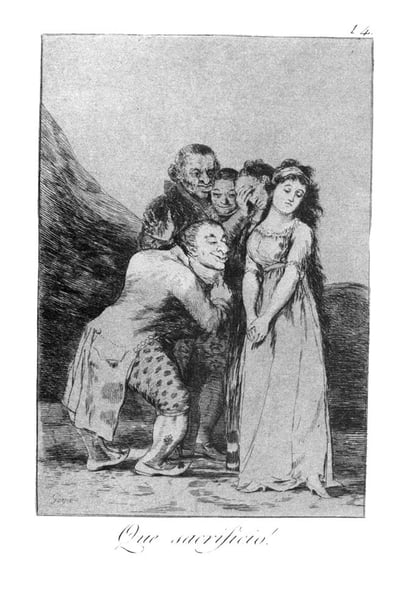
Francisco Goya sanatçısının What a sacrifice! eseri hakkında uzman analizi
Tarz: Romanticism · Tür: caricature
Expert Analysis of "What a sacrifice!" by Francisco Goya
This work exemplifies Goya’s masterful fusion of Romanticism with the biting social commentary of caricature.
Significance within Romanticism:
Romanticism prized emotional intensity, individualism, and a critical view of established power. Here, Goya channels those ideals by using exaggeration and grotesque distortion—hallmarks of caricature—to amplify the inherent absurdity and cruelty of the "sacrifice" depicted. Rather than a heroic or religious martyrdom, the scene becomes a searing indictment of irrationality, superstition, or political folly. This aligns with Romanticism’s fascination with the dark, irrational side of human nature and its distrust of institutional authority.
Significance as a Caricature:
Caricature in Goya’s hands transcends mere humor. It becomes a weapon of moral outrage. By distorting facial features, poses, or the implied narrative, Goya forces the viewer to feel the horror and stupidity of the situation. The title’s ironic tone—"What a sacrifice!"—mockingly praises an act that is clearly wasteful or cruel. This technique anticipates later satirists and solidifies Goya’s role as a pioneer who elevated caricature from lowbrow entertainment to profound social critique.
Overall:
The work is significant because it demonstrates how Romanticism’s emotional extremes and caricature’s formal exaggeration can merge to produce a timeless commentary on human folly, making Goya a forefather of modern political and social satire.
Görsel olarak benzer
İlişkili kompozisyon ve renk paletine sahip 20 eser
Nuccia accepts Meo Patacca for her husband (Plate 52/52)
Bartolomeo Pinelli
Lads getting on with the job
Francisco Goya
To the Count Palatine
Francisco Goya
Even so he cannot make her out
Francisco Goya
Who is more overcome?
Francisco Goya
Disordered
Francisco Goya
Are you … Well, as I was telling you. Eh! Be careful or...
Francisco Goya
It is better to be idle
Francisco Goya
They say 'yes' and give their hand to the first comer
Francisco Goya
The First Kiss of Love
Pierre-Paul Prud'hon
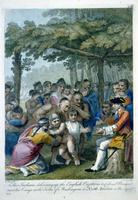
The Indians Delivering up the English Captives to Colonel Bouquet near his camp at the folks of Muskingum, North America in November 1764
Benjamin West
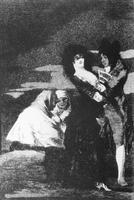
Birds of a Feather
Francisco Goya
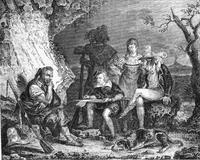
Depicted with Brigants
Salvator Rosa
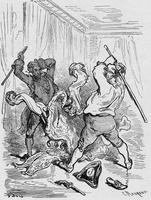
Illustration for Baron von Münchhausen
Gustave Dore
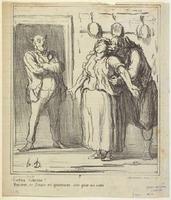
Zounds, Catherine
Honore Daumier
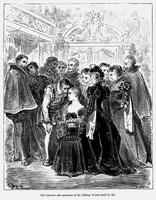
Don Quixote
Gustave Dore
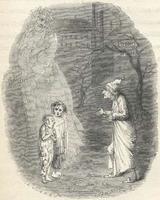
Ignorance and Want
John Leech
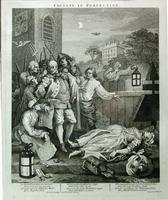
Cruelty in perfection
William Hogarth
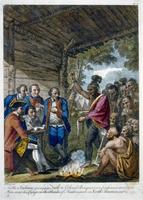
The Indians giving a talk to Colonel Bouquet in a conference at a council fire, near his camp on the banks of Muskingum in North America in Oct. 1764
Benjamin West
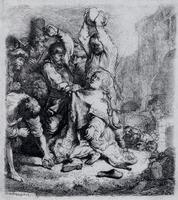
The Stoning Of St. Stephen
Rembrandt