
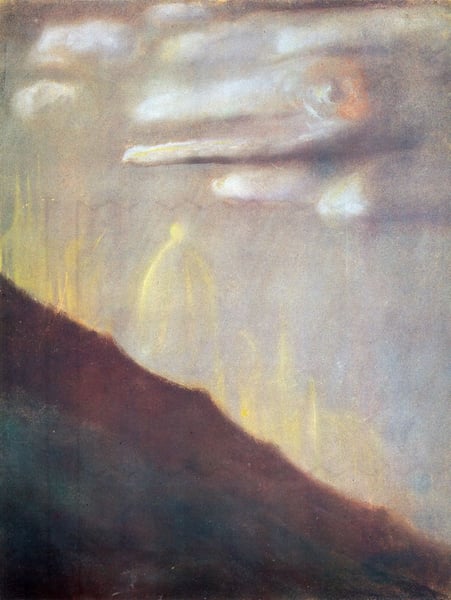
Экспертный разбор работы «Deluge (VIII)» художника Mikalojus Konstantinas Ciurlionis
Стиль: Symbolism · Жанр: symbolic painting
Expert Analysis of "Deluge (VIII)" by Mikalojus Konstantinas Čiurlionis
As a work firmly rooted in Symbolism and classified as a symbolic painting, "Deluge (VIII)" holds significance primarily through its embodiment of Symbolism's core tenets: the rejection of literal representation in favor of mythic, emotional, and cosmological subject matter. Čiurlionis, a Lithuanian painter and composer, is renowned within the Symbolist movement for his ability to fuse visual art with musical structure and spiritual allegory.
The title "Deluge" immediately invokes the biblical flood—a universal symbol of destruction, purification, and cosmic rebirth. Within the Symbolist tradition, such a theme is not rendered as a historical or descriptive scene but as a psychological and metaphysical event. The "VIII" designation suggests this painting is part of a series, reinforcing the Symbolist interest in cyclic, narrative, or musical sequences (evoking movements in a symphony). This cyclical approach is itself a significant contribution: Čiurlionis treats painting as a temporal, almost musical art, where meaning unfolds across multiple images rather than in a single frozen moment.
The genre of symbolic painting is crucial here. Instead of depicting a realistic flood, Čiurlionis likely uses abstracted, fluid forms, muted or dramatic color harmonies, and ambiguous spatial depths to evoke the sensation of an overwhelming, primordial force. The absence of explicit human figures (common in his work) shifts focus from anecdote to archetype. The painting becomes a visual equivalent of a mood—solemn, apocalyptic, yet transcendent—that aligns with Symbolism’s desire to express the ineffable.
What makes "Deluge (VIII)" significant within its style is its radical synthesis of music, nature, and mysticism. Čiurlionis stands apart from mainstream French Symbolists (like Moreau or Redon) by embedding his symbolic imagery within a highly personal, northern European sensibility—one that draws on Lithuanian folklore and cosmic pantheism. In this work, the deluge is not merely punishment but a stage in a cosmic cycle, reflecting Symbolism’s broader fascination with the occult, theosophy, and the subconscious.
Thus, the artwork’s importance lies in how it uses the symbolic painting genre to transform a traditional myth into a lyrical, abstract vision of universal forces—a hallmark of Čiurlionis’s unique contribution to the Symbolist movement.
Визуально похожие
20 работ с близкой композицией и палитрой
Deluge (II)
Mikalojus Konstantinas Ciurlionis
Landscape with a River and a Bay in the Background
J.M.W. Turner
Val d'Aosta: Snowstorm, Avalanche and Thunderstorm
J.M.W. Turner
Oberitalienischer Gebirgssee
Lesser Ury
The Dog
Francisco Goya
Seascape
Jean-Baptiste Carpeaux
Paisaje blanco
Armando Reveron
Goldau
J.M.W. Turner
Sunrise at Zao
Fujishima Takeji
My road (I)
Mikalojus Konstantinas Ciurlionis
Shade and Darkness, The Evening of The Deluge
J.M.W. Turner
Mountain
Mikalojus Konstantinas Ciurlionis
Creation of the World XIII
Mikalojus Konstantinas Ciurlionis
21-08-1995
Zao Wou-Ki
Sunset
Mikalojus Konstantinas Ciurlionis
Monhegan (Shining of night)
Nicholas Roerich
Niitakayama
Fujishima Takeji
Sunrise
Tom Roberts

Hypnagogic Monument
Salvador Dali
Untitled
Zdzislaw Beksinski