Analisi esperta di The Offering di Mikalojus Konstantinas Ciurlionis
Stile: Symbolism · Genere: symbolic painting
An Expert Analysis of "The Offering" by Mikalojus Konstantinas Čiurlionis
Within the realm of Symbolism, Mikalojus Konstantinas Čiurlionis’s "The Offering" stands as a profoundly significant work, not merely for its haunting beauty but for how it embodies the movement’s core ambition: to transcend the physical world and evoke the spiritual and musical dimensions of existence.
Stylistic and Period Significance
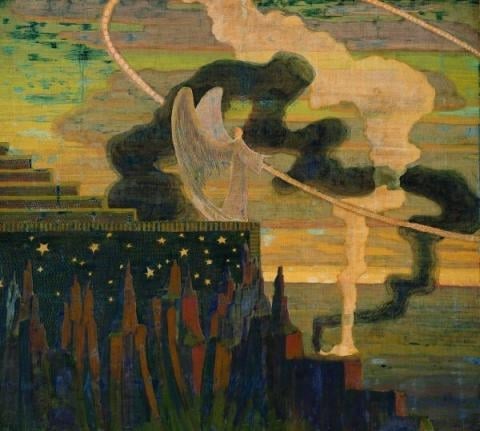
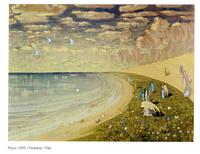
As a Symbolist painting, "The Offering" deliberately rejects the naturalistic depiction of the visible world in favor of a subjective, dreamlike reality. What makes this work extraordinary within the Symbolist canon is Čiurlionis’s unique synthesis of painting with musical structure. A trained composer, he often organized his visual compositions like symphonic movements—rhythmic, layered, and full of tonal contrasts. In "The Offering", this manifests in the floating, ethereal forms that seem to resonate with an unheard melody, creating a sense of temporal flow rather than frozen stillness.
The genre of "symbolic painting" here is pushed to its philosophical limit. Rather than using conventional symbols (e.g., a dove for peace), Čiurlionis invents a private mythology. The central act of offering is ambiguous: Is it a sacrifice, a gift, or a prayer? This ambiguity is central to the work’s significance—it invites the viewer into an internal, meditative state, a hallmark of High Symbolism.
What Makes It Significant
-
Integration of Cosmic and Personal Symbolism
Čiurlionis merges vast, cosmic landscapes (often featuring distant suns or layered horizons) with intimate human gestures. In "The Offering", the offering figure is dwarfed by the surrounding atmosphere, suggesting humanity’s place within a larger, unknowable spiritual order. This reflects the Symbolist fascination with the sublime and the occult, but Čiurlionis avoids melodrama in favor of quiet mystery. -
Musicality of Form
The composition is structured like a fugue: repeating, undulating lines (such as waves or hilltops) and delicate, luminous colors (pale greens, golds, and blues) create a visual rhythm. This was radical for its time—while other Symbolists like Gustave Moreau painted static, jewel-like scenes, Čiurlionis painted movement as a metaphor for the soul’s journey. "The Offering" thus becomes a visual score, where the paint itself seems to vibrate with sonic energy. -
Pioneering National Identity within Symbolism
Though universal in theme, the painting is steeped in Lithuanian folk consciousness. The offering might evoke Baltic mythological rituals, but it is filtered through a modern, cosmopolitan Symbolist lens. This placed Čiurlionis at the forefront of a national art movement that could speak to global Symbolist currents without losing its cultural roots—a rare achievement in early 20th-century European art. -
Exquisite Ambiguity
The work’s enduring power lies in its refusal to explain itself. The viewer is left with a sensation of reverence and melancholy, as if witnessing a ritual from a forgotten age. This emotional directness—achieved without narrative clarity—is the ultimate Symbolist goal: to feel before understanding.
Conclusion
"The Offering" is significant because it represents Symbolism at its most synthesized, integrated, and transcendent. Čiurlionis does not merely illustrate symbols; he creates an experiential space where music, myth, and personal vision converge. The painting stands as a testament to the movement’s belief that art should be a bridge to the infinite—and few bridges are as hauntingly beautiful as this one.
Visivamente simili
20 opere con composizione e palette affini
Hymn (II)
Mikalojus Konstantinas Ciurlionis
Alegro (Sonata of the Pyramids)
Mikalojus Konstantinas Ciurlionis
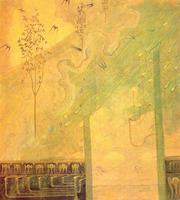
Scherzo (Sonata of the Summer)
Mikalojus Konstantinas Ciurlionis
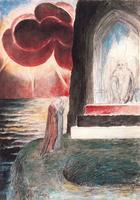
Illustration to Dante's Divine Comedy, Purgatory
William Blake
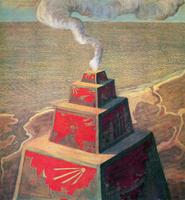
The altar
Mikalojus Konstantinas Ciurlionis
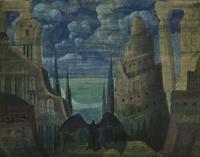
The Demon
Mikalojus Konstantinas Ciurlionis
Scherzo (Sonata of the Pyramids)
Mikalojus Konstantinas Ciurlionis
THE DIVINE JERUSALEM
Ernst Fuchs
Those Who Eat Crabs. Part of the Diptych
Dmytro Kavsan
A World
Ángeles Santos Torroella
Study for the Backdrop of 'Mad Tristan' (Act II)
Salvador Dali
Allegro (Sonata of the Sun)
Mikalojus Konstantinas Ciurlionis
Prelude
Mikalojus Konstantinas Ciurlionis
Mural Painting for Helena Rubinstein (panel 2)
Salvador Dali
Christ
Nicholas Roerich
Evening bells
Carlos Schwabe
Six Swans
Kay Nielsen
The Lugubrious Game
Salvador Dali
Paradise
Mikalojus Konstantinas Ciurlionis
Illustration to Dante's Divine Comedy, Hell
William Blake