Analyse experte de Portrait of E. I. Nekludova de Vladimir Borovikovsky
Style : Rococo · Genre : portrait
Expert Analysis of Portrait of E. I. Nekludova by Vladimir Borovikovsky
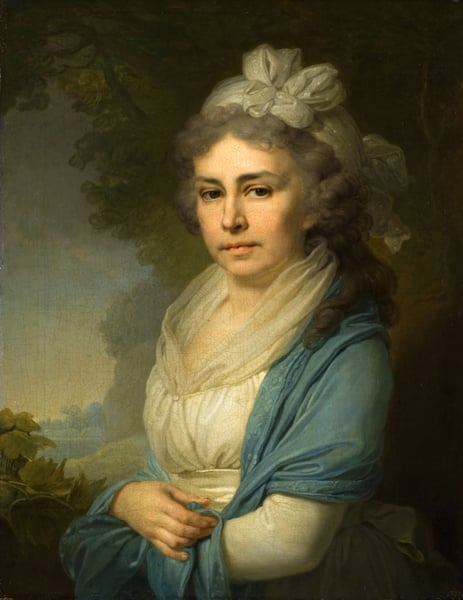
This portrait is a quintessential example of Rococo painting as interpreted by Russia’s leading portraitist of the late 18th and early 19th centuries. The work’s significance lies in how it adapts the playful, decorative elegance of Western European Rococo to the refined, sentimental sensibility of the Russian aristocracy.
Stylistic Significance within Rococo:
Borovikovsky employs the classic Rococo traits of soft, diffused lighting and a delicate, pastel color palette—likely featuring pale pinks, silvery whites, and muted greens—to create an atmosphere of intimate grace. The figure of E. I. Nekludova is depicted with the characteristic Rococo emphasis on feminine charm and a gentle, almost dreamy expression. The brushwork is smooth and liquid, minimizing sharp outlines and blending the sitter into a softly rendered, often bucolic background—a hallmark of the style that evokes a pastoral idyll.
Genre and Period Context:
As a portrait, the work is notable for its psychological nuance. Unlike earlier formal state portraits that emphasized power and status, Borovikovsky’s approach emphasizes the sitter’s inner life and personal sensibility. This aligns with the broader Rococo shift toward capturing the “cult of feeling” and the delicate emotions of the private individual. Borovikovsky was instrumental in bringing these European trends to Russian painting, merging them with a specifically Russian sense of noble simplicity and introspection.
Art Historical Importance:
The Portrait of E. I. Nekludova stands as a key artifact of the Russian Enlightenment, where Rococo aesthetics served not merely as decoration but as a vehicle for expressing an idealized, refined humanity. Borovikovsky’s work bridges the lightness of Rococo with the emerging Neoclassical interest in clarity and moral sentiment, making this portrait a significant synthesis of styles. It captures a fleeting moment of aristocratic elegance while hinting at the changing social and artistic currents that would soon give way to Romanticism.
Visuellement similaire
20 œuvres à la composition et à la palette proches
Portrait of Ekaterina Aleksandrovna Novosiltseva
Vladimir Borovikovsky
Portrait of Princess N.I. Kurakin
Vladimir Borovikovsky
Portrait of Empress Elisabeth Alexeievna
Vladimir Borovikovsky
Grand Duchess Elena Pavlovna of Russia
Vladimir Borovikovsky
Portrait of M.I.Lopukhina
Vladimir Borovikovsky
Self portrait
Ulrika Pasch
Varvara Andreyevna Tomilova
Vladimir Borovikovsky
Darya Alexandrovna Valuev
Vladimir Borovikovsky
Princess Lopukhina
Vladimir Borovikovsky
Portrait of Grand Duchess Alexandra
Vladimir Borovikovsky
Portrait of Maria Dyakova
Dmitry Levitzky
Countess Vera Zavadovskaya
Vladimir Borovikovsky
Portrait of Martha Arbeneva
Vladimir Borovikovsky
Sarah Siddons (née Kemble)
Gilbert Stuart
Miss Hariot Milles
George Romney
Mary Myers Hale
Thomas Sully
Portrait of Catherine Vasilevny Torsukovoy
Vladimir Borovikovsky
Portrait of Elena Alexandrovna Naryshkina
Vladimir Borovikovsky
A Young Lady in a Yellow Gown with Blue Ribbons
Jean-Baptiste Perronneau
Mrs. Joseph Anthony Jr. (Henrietta Hillegas)
Gilbert Stuart