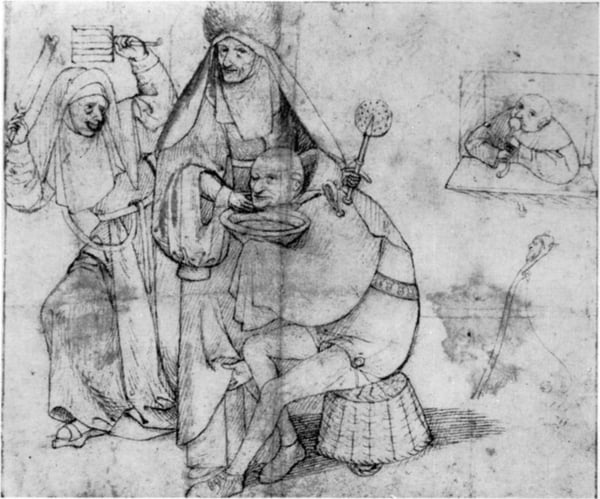
A comical barber scene
Expertenanalyse zu Hieronymus Boschs A comical barber scene
Stil: Northern Renaissance · Genre: sketch and study
Expert Analysis: "A Comical Barber Scene" by Hieronymus Bosch
As a rare surviving sketch or study from the hand of Hieronymus Bosch, A Comical Barber Scene offers a singular glimpse into the creative process of one of the Northern Renaissance’s most enigmatic and imaginative masters. While Bosch is celebrated for his fantastical, morally charged altarpieces and triptychs, his preparatory drawings are exceptionally scarce—making this work a crucial artifact for understanding how he developed his distinctive blend of satire, caricature, and social commentary.
Significance within the Northern Renaissance
In the context of the Northern Renaissance, which prized meticulous observation, moral allegory, and the interplay between the sacred and the profane, Bosch’s sketch stands out for its coarse, domestic humor. The “comical” barber scene likely depicts a quack or a foolish tradesman—a recurring Boschian theme that critiques human folly, vanity, and the corruption of everyday professions. By choosing a lowly barber (often associated in the period with bloodletting, tooth-pulling, and questionable medical practices), Bosch aligns himself with the Northern tradition of moralizing genre scenes, but he infuses it with a grotesque, exaggerated energy that anticipates later Flemish caricature.
Artistic and Technical Significance
As a sketch and study, the work reveals Bosch’s hand at its most spontaneous. The loose, energetic lines and lack of finished detail suggest he was testing compositions or recording a passing idea. This informality is invaluable for art historians: it showcases the artist’s raw observational wit—the way he deforms human features for comic effect—and his ability to distill a narrative into a few deft strokes. The very existence of such a study underscores that, even in preparatory form, Bosch’s works were not merely religious or fantastical but also grounded in the satirical critique of contemporary life.
In summary, A Comical Barber Scene is significant not only as a unique record of Bosch’s creative methodology but also as a clear example of how Northern Renaissance artists used even fleeting sketches to provoke thought, laughter, and moral reflection. It reminds us that behind Bosch’s nightmarish visions lay a sharp, everyday sense of the absurd.
Museum / Gallery
Visuell ähnlich
20 Werke mit ähnlicher Komposition und Farbpalette
Group of Male Figures
Hieronymus Bosch
Mary and John (Mary and John at the Foot of the Cross)
Hieronymus Bosch
The Visitation of the Virgin to Saint Elizabeth; King Solomon in a Niche at Left
Carlo Urbino
Temptation of St Anthony
Hieronymus Bosch
The Holy Family
Lucas van Leyden
Two witches
Hieronymus Bosch
Anger makes the mouth swell and blackens the blood in the veins
Pieter Bruegel the Elder
Witches
Hieronymus Bosch
Studies on a great "picture of the Virgin" Madonna with child, ten saints and angels
Albrecht Durer
Study for 'The Knight's Dream'
Raphael
Holy Family
Albrecht Durer
Sketches for a Temptation of St. Anthony
Hieronymus Bosch
Entombment
Albrecht Durer
Lamentation over the Dead Christ
Raphael
Romeo and Juliet, Overlooked by Friar Lawrence
Simeon Solomon
Two Caricatured Heads
Hieronymus Bosch
Studies
Hieronymus Bosch
The holy family
Albrecht Durer
Visitation
Albrecht Durer
Death and the Miser
Hieronymus Bosch