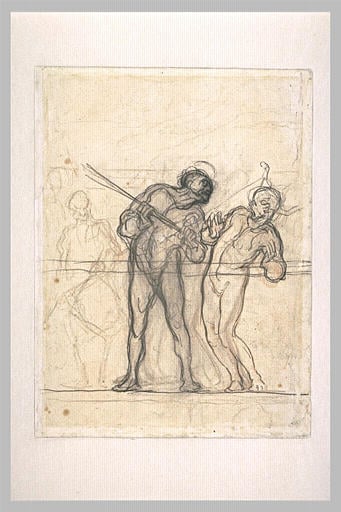
Study for the Parade
Expertenanalyse zu Honore Daumiers Study for the Parade
Stil: Realism · Genre: sketch and study
Analysis of "Study for the Parade" by Honoré Daumier
As a prime example of Realism executed in the form of a sketch and study, this work reveals Daumier’s revolutionary approach to capturing modern life. Unlike the polished, idealized history paintings of his era, Daumier’s study prioritizes immediacy and psychological truth over finish.
The piece’s significance lies in how it distills Realism’s core mission: to observe and record the unglamorous realities of 19th-century Parisian society. As a study, it offers a rare window into Daumier’s creative process—rapid, energetic strokes convey the movement and tension of a street performer or crowd, celebrating the raw, fleeting gesture over academic perfection. This spontaneity anticipates modern sketching and even Impressionism’s emphasis on capturing a moment.
Furthermore, Daumier’s focus on a “parade” (likely a traveling show or circus scene) elevates the marginalized performer and the everyday spectacle, defying Romanticism’s heroic subjects. In its unfinished state, the sketch embodies realism’s radical honesty: art as a direct, unvarnished transcript of life.
Visuell ähnlich
20 Werke mit ähnlicher Komposition und Farbpalette
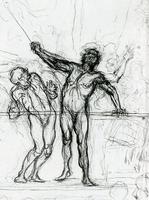
Study for the Parade
Honore Daumier
The Drunkeness Of Noah
Jean-Francois Millet
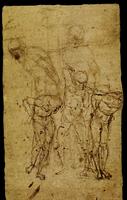
Study for a Flagellation
Andrea Mantegna
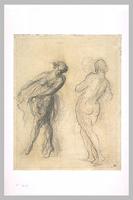
Two sketches for a dancer
Honore Daumier
Dying cadet
Ferdinand Hodler
Standing Male Nude
Vincent van Gogh
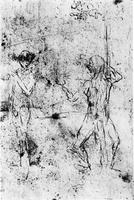
The temptation of Eve by the serpent
Hieronymus Bosch
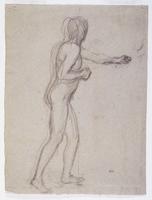
Study of a Standing Male Nude
Pierre Puvis de Chavannes
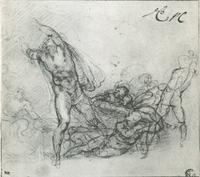
Study for a "Resurrection of Christ"
Michelangelo
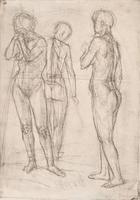
Kondor Béla, Három Akt
Kondor Béla
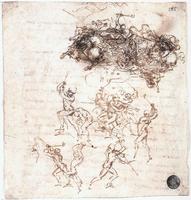
Study of battles on horseback and on foot
Leonardo da Vinci
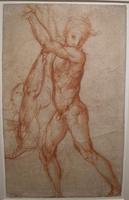
Study of nude
Jacopo Pontormo
The Oath in the Tennis Court
Jacques-Louis David
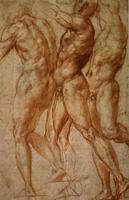
Joseph in Egypt
Jacopo Pontormo
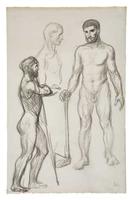
Etude des Hommes
Theophile Steinlen
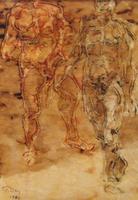
Two Men Walking
Mark Tobey
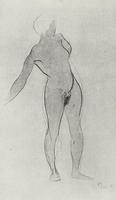
The Model
Kuzma Petrov-Vodkin
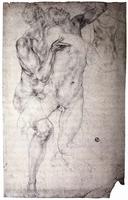
Two nudes
Jacopo Pontormo
Immediately three goddesses arise (plate 11)
Odilon Redon
Studies of a Female Figure
Noè Bordignon