Expertenanalyse zu Honore Daumiers Sunday
Stil: Realism · Genre: caricature
Expert Analysis: "Sunday" by Honoré Daumier (Realism / Caricature)
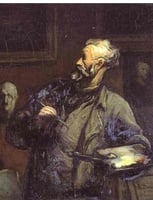
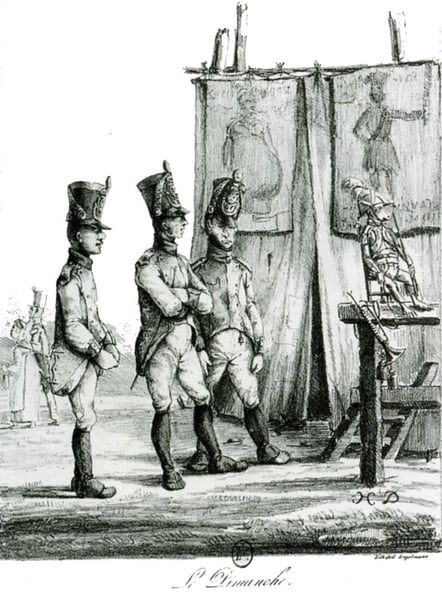
Honoré Daumier’s "Sunday" stands as a masterful synthesis of Realism and caricature, a combination that distinguishes the artist as one of the most incisive social commentators of 19th-century France. While Daumier is celebrated for his satirical lithographs for journals such as Le Charivari, his work transcends mere humor by grounding its exaggerated forms in the harsh realities of everyday life.
What makes "Sunday" significant is its unflinching yet compassionate portrayal of the Parisian lower and middle classes during a period of rapid urbanization and class tension. Daumier does not mock his subjects; instead, he uses caricature’s distortion—flattened faces, weary postures, and exaggerated expressions—to emphasize the physical and emotional toll of a single day of rest. The scene likely depicts a family or a couple trudging through a meager Sunday outing, their cramped, stooped bodies clashing against any notion of leisurely ease. The ragged clothing, hollow eyes, and slumped shoulders are rendered with a Realist’s commitment to truthfulness, stripping away romantic idealization.
Technically, Daumier’s lithographic linework is both fluid and razor-sharp. He builds form through dense, crosshatched shadows that evoke the soot-stained streets of Paris, while the figures’ faces are compressed into near-grotesque geometry—a hallmark of caricature that, here, serves social critique rather than cruelty. The title itself, "Sunday," is ironic: instead of rest or spiritual renewal, Daumier shows exhaustion, boredom, or the grim ritual of pretending to enjoy a day free from labor.
In the context of Realism, Daumier’s caricatures are often overlooked in favor of painters like Courbet or Millet, yet his lithographs are equally rooted in observation of the “real.” "Sunday" embodies the Realist mission to document the unheroic, the ordinary, and even the ugly. By giving such dignity to the downtrodden through the very genre meant to mock them, Daumier elevates the caricature into a weapon of social awareness. This work is therefore significant not only as a fine example of his graphic skill but as a lasting testament to art’s power to expose the gap between society’s ideals (a “Sunday of repose”) and the lived experience of those it forgets.
Visuell ähnlich
20 Werke mit ähnlicher Komposition und Farbpalette
The Consignés taking the Weapons for the Chore of the Neighborhood
Nicolas Toussaint Charlet
The Swiss guard at the Louvre
Théodore Géricault
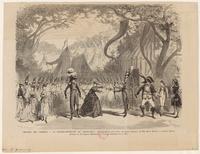
Press Illustration of Act 1 of the Premiere of Jacques Offenbach's Operetta La Grande-duchesse De Gérolstein at the Théâtre Des Variétés in Paris on 12 April 1867 from L'univers Illlustré (27 April 1867)
Edouard Riou
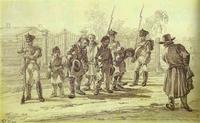
Convicts under Escort
Alexander Orlowski
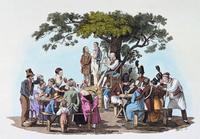
People's scene in the Prater / Amusement in the Prater
Johann Nepomuk Passini
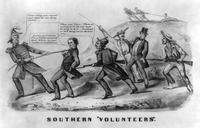
Unionists throughout the Confederate States, including Germans, resisted the imposition of conscription in
Currier and Ives
Royal Austrian national Landwehr
Heinrich Papin
Part of a Series Chronicling the Uniforms of Napoleon's Grande Armée.
Carle Vernet
Press Illustration of Act 1 of the Premiere of Jacques Offenbach's Operetta La Grande-duchesse De Gérolstein at the Théâtre Des Variétés in Paris on 12 April 1867 from L'univers Illlustré (27 April 1867)
Edouard Riou
The (Franco-Prussian) War: Fall of Strasbourg - Departure of French Prisoners
William Simpson
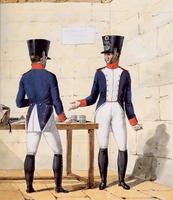
Part of a Series Chronicling the Uniforms of Napoleon's Grande Armée.
Carle Vernet
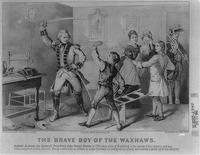
The brave boy of the Waxhaws
Currier and Ives
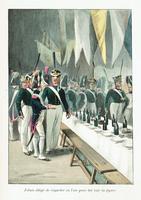
J'étais Obligè De Regarder En L'air Pour Lui Vour La Figure
Julien Le Blant
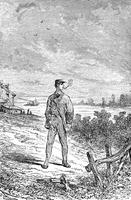
Journey to the Center of the Earth
Edouard Riou
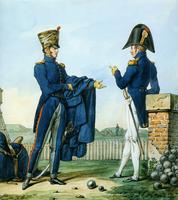
Part of a Series Chronicling the Uniforms of Napoleon's Grande Armée.
Carle Vernet
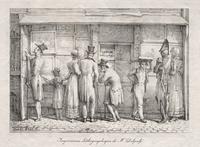
Delpech Lithographic Print Shop
Carle Vernet
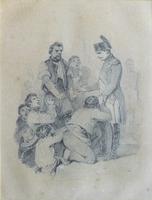
The crowd crowds around the emperor in the gardens of the Elysee
Nicolas Toussaint Charlet
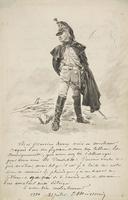
Letter to Samuel P Avery with a Drawing of a Military
Ernest Meissonier
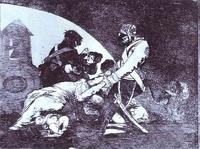
Not For Those
Francisco Goya
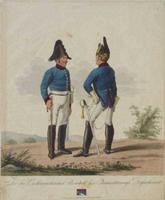
Royal Austrian Troops
Heinrich Papin