The Intermission
Expert analysis of Honore Daumier’s The Intermission
Style: Realism · Genre: genre painting
Expert Analysis: "The Intermission" by Honoré Daumier
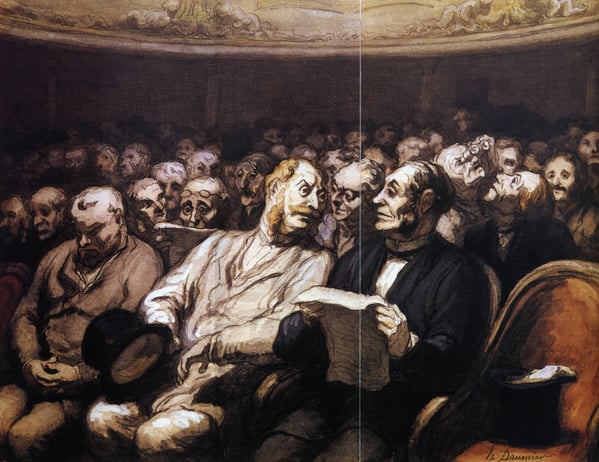
Honoré Daumier’s The Intermission is a quintessential example of Realist genre painting, distinguished by its unflinching observation of modern urban life. Unlike the idealized subjects of Romanticism or Academic art, Daumier turns his attention to the mundane, fleeting moments of the Parisian middle class. Here, the intermission of a theatrical performance becomes a microcosm of social performance itself.
Significance within Realism and Daumier’s oeuvre:
-
Psychological realism over physical idealization: Daumier captures not just the physical appearance of his subjects but their interior states—boredom, fatigue, anticipation, or quiet desperation. The figures are not posed heroically; they slump, stare into space, or engage in distracted conversation. This emphasis on psychological truth aligns with Realism’s rejection of theatricality.
-
Satirical edge with humanist depth: Daumier was a master caricaturist and social critic. In The Intermission, the apparent banality conceals a subtle critique of bourgeois leisure. The audience, momentarily freed from the play’s illusion, reveals its own contradictions: the desire for escape, the burden of social performance, and the isolation even in a crowd. Yet Daumier tempers his satire with empathy, making the scene feel universal.
-
Technical innovations: Daumier’s loose, gestural brushwork and muted, almost grisaille palette anticipate both Impressionism and Expressionism. He reduces detail to suggest form, focusing on postures and glances rather than precise anatomy. This technique underscores the transitory nature of the scene—a snapshot of modern life in flux.
-
Contribution to democratic art: By elevating a trivial intermission to the level of historical painting, Daumier affirms Realism’s core belief that the ordinary lives of ordinary people are worthy of serious artistic contemplation. The Intermission is not merely a genre scene; it is an essay on the human condition in the age of spectacle.
In essence, Daumier transforms a quiet, undramatic moment into a rich meditation on class, consciousness, and the theater of everyday existence—making this work a landmark of Realist social observation.
Visually similar
20 works with related composition and palette
The Concert
Magnus Enckell
Four Amateur Print Lovers
Honore Daumier
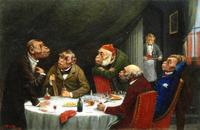
After Dinner Discourse
William Holbrook Beard
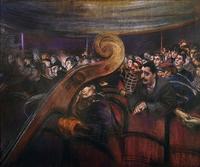
At the theatre
Giovanni Boldini
Illustration to the Great Deputation, Which Tried to Convince the Czar to Withdraw the February Manifesto Which Strove to Russify Finland
Albert Edelfelt
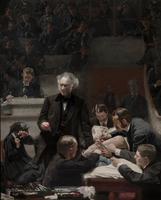
The Gross Clinic
Thomas Eakins
The Agnew Clinic
Thomas Eakins
The Legislative Belly
Honore Daumier
In the upper tier of the theater
Ilya Repin
The Assassination of the US President William Mckinley, Buffalo (NY) 1901
Achille Beltrame
At the Masquerade
Charles Hermans
Les Poètes Du Parnasse
Paul Émile Chabas
Story Le Rubis Du Grand-lama
Edouard Riou
Meeting of thirty-five heads of expression
Honore Daumier
L'Ennemi du Peuple
Theophile Steinlen
Lithography for the series "Les Enfants Terribles''
Paul Gavarni
Three Amateurs in front of the Night Review of Raffet
Honore Daumier
Theatre in Martigues
Raoul Dufy
the Last Hours of Abraham Lincoln
Alonzo Chappel
17th of May Norwegian Constitution Day 17 De Mai
Theodor Severin Kittelsen