Expertenanalyse zu Ivan Kramskoys Family Artist
Stil: Realism · Genre: portrait
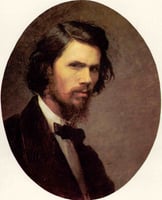
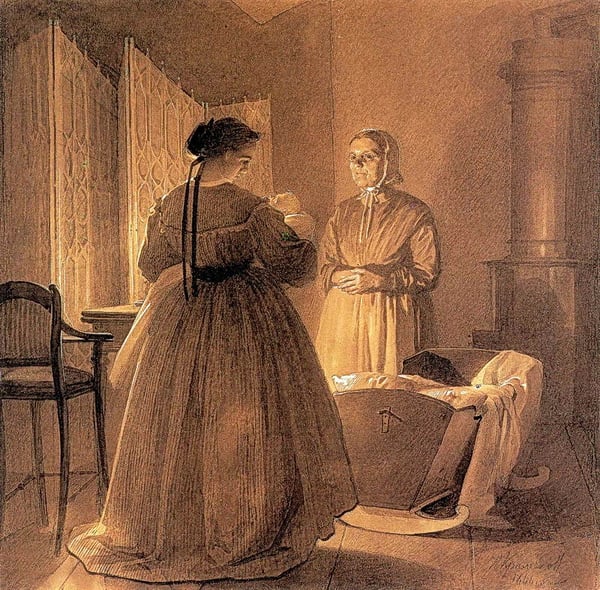
The significance of Ivan Kramskoy’s Family Artist lies in its profound challenge to the conventions of official portraiture, embodying the core ideals of Russian Realism and the Peredvizhniki (Wanderers) movement. Painted with a psychological depth that was revolutionary for its time, the work eschews the grand, idealized poses typical of aristocratic or salon portraits in favor of an intimate, truthful snapshot of domestic life.
Kramskoy, as a leader of the Realist revolt against the Imperial Academy of Arts, used the portrait genre to explore the inner life of his subjects. In Family Artist, the artist depicts his own household (likely his wife and children) not as static figures but as a living, breathing unit caught in a fleeting, unguarded moment. The composition focuses on the tender, everyday interactions—the subtle exchange of glances, the natural grouping of figures around a table or interior space—rather than on formal hierarchy.
This approach is significant for several reasons. First, it elevates the ordinary domestic sphere to the status of high art, a direct reflection of the Peredvizhniki’s commitment to depicting the authentic Russian experience, free from academic pretension. Second, Kramskoy’s masterful handling of light and shadow (chiaroscuro) serves not merely as a technical exercise but as a vehicle for emotional resonance. Soft, diffused lighting models the faces with gentle realism, emphasizing the warmth of familial bonds and hinting at the quiet anxieties and joys of the artist’s own life.
Finally, the work stands as a testament to Kramskoy’s own artistic manifesto: that a portrait should reveal the “truth of character” and the social or psychological context of the sitter. By turning the lens on his own family, he creates a universally relatable yet deeply personal narrative, making Family Artist a cornerstone of Russian Realism that anticipates the psychological portraiture of later masters like Repin.
Visuell ähnlich
20 Werke mit ähnlicher Komposition und Farbpalette
Mother knows best
Pierre Jean Edmond Castan
The Christening
George Harvey
Sewing bee
Jules Trayer
Bedtime
Arthur Hacker
The Dying Child
Theodor Leopold Weller
Jeune femme assise
Joseph Bail
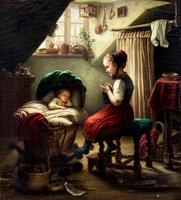
A lullaby
Meyer von Bremen
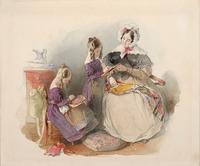
Princesses Elise and Fanny Liechtenstein
Peter Fendi
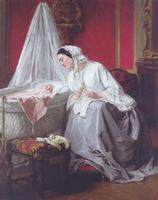
A tender moment
Jules Trayer
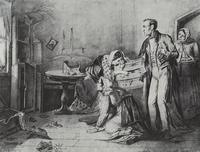
Burglary at Easter Eve
Vasily Perov
The Morning Toilette
Jean-Baptiste-Simeon Chardin
Tafereelen uit het burgerlijke leven
Cornelis Troost
A Doctor and Some Women Attend to and Prepare Band
Albert Lynch
Lady at the Dressmaker
Pietro Longhi
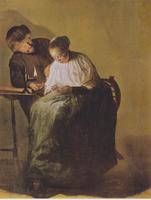
A man offers a young girl money
Judith Leyster
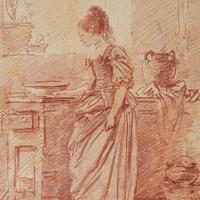
Die hübsche Köchin
Johann Anton de Peters
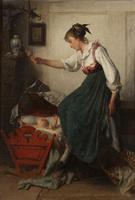
The new rattle
Theodore Gerard
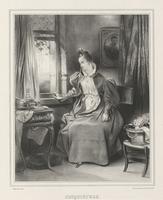
Worry
Achille Devéria
Borch Woman Sewing
Gerard Terborch
Mother Teaching Daughter Prayers
Jules Trayer