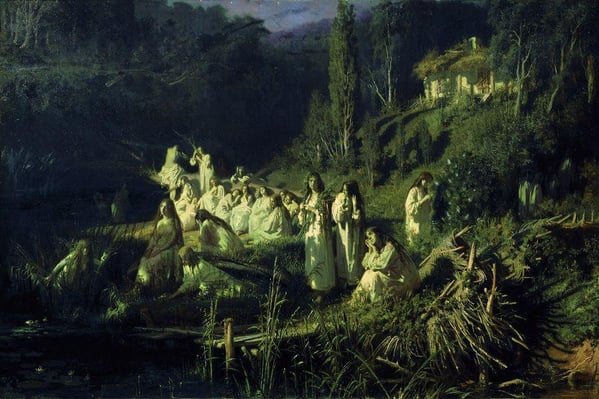
As an expert analysis of "Mermaids" by Ivan Kramskoy, using only the provided facts—that it belongs to the Realism style and the mythological painting genre—its significance lies in the bold fusion of two seemingly contradictory artistic modes.
In the context of 19th-century Russian art, Realism was defined by its commitment to depicting contemporary life, social truths, and the everyday struggles of ordinary people. By applying this rigorous, naturalistic style to a mythological subject—a scene of mermaids—Kramskoy performed a radical act of artistic translation. He did not treat the mermaids as idealized, otherworldly figures from academic fantasy. Instead, he depicted them with the same meticulous attention to light, atmosphere, and humanlike anatomy that he would use for a realist portrait or landscape.
This tension is what makes the work significant: it uses the visual language of Realism to make the supernatural feel physically present and psychologically unsettling. The mermaids are not ethereal nymphs but eerily tangible beings, grounded in a moonlit natural setting. Kramskoy thus challenges the viewer to question the boundary between the observable world and the world of folklore, expanding the scope of Realism from social critique to a philosophical exploration of mortality, nature, and the uncanny. The painting stands as a landmark because it refuses to separate realism’s truthfulness from myth’s symbolic power, creating a unique hybrid that broadened the possibilities of 19th-century painting.