Fernand Leger の Nudes in the Forest の専門的な分析
スタイル:Cubism, Tubism · ジャンル:nude painting (nu)
Expert Analysis of Nudes in the Forest by Fernand Léger
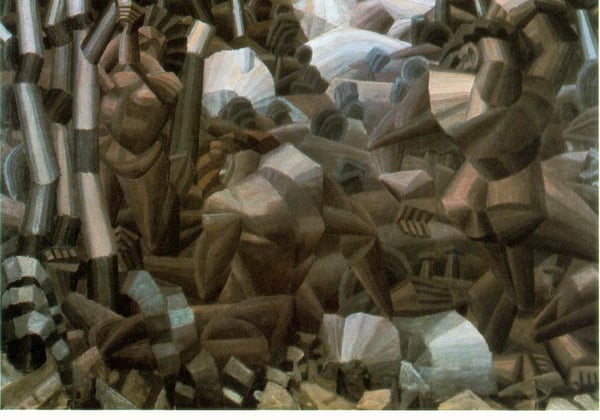
Fernand Léger’s Nudes in the Forest (1909–1910) stands as a pivotal and radical statement within early Cubism, and it is arguably the foundational work of the artist’s signature style later known as Tubism. While the genre is the traditional nude (nu), Léger completely overturns classical expectations, transforming the human body into a series of metallic, cylindrical volumes that merge with the surrounding forest.
Significance within Cubism and Tubism:
-
Breaking with Naturalism: Unlike the analytical Cubism of Picasso and Braque, which fractured forms into intersecting planes, Léger reduces both figures and trees to a bold, industrial vocabulary of pipes, cones, and cylinders. This mechanistic treatment of the human form anticipates Léger’s lifelong fascination with modern machinery and urban life.
-
Tubism as a Distinctive Sub-Style: “Tubism” is the term coined for Léger’s unique approach within Cubism, and Nudes in the Forest is its manifesto. The bodies of the nudes are built from interlocking tubular sections, creating a sense of weight, volume, and almost robotic solidity. The forest itself becomes a grid of abstracted, tubular tree trunks, erasing the boundary between figure and setting.
-
From Pastoral to Industrial: By recasting the classical nu (nude) in a forest—a traditional pastoral theme—into a mechanized, almost futuristic scene, Léger directly challenges the Romantic and academic traditions. The painting is significant for its aggressive denial of fleshiness and softness; instead, it offers a dehumanizing yet powerful vision of humanity as part of a constructed, modern world.
-
Monumental Technique: Executed in a limited palette of grays, browns, and greens, the painting’s heavy outlines and thick, modeled forms give it a sculptural, almost monolithic presence. This work influenced not only later Cubist sculpture but also the rise of Purism and the machine aesthetic of the 1920s.
In summary, Nudes in the Forest is a watershed artwork that defines Tubism within Cubism, marking Léger’s transition from traditional figure painting to a bold, mechanized modernism. Its significance lies in how it uses the nude—one of art’s oldest subjects—to announce the arrival of an industrial, abstracted world.
Museum / Gallery
視覚的に類似
構図やパレットが近い作品 20 件
Lied I
Albert Bloch
Ascension
Kmetty János
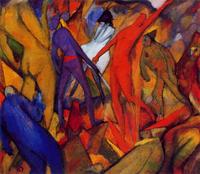
Untitled (Infernal figures)
Albert Bloch
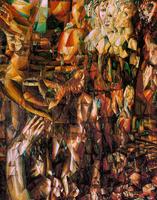
A Couple
Pavel Filonov
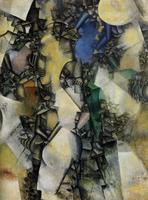
The Wedding
Fernand Leger
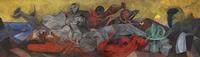
America
Rufino Tamayo
Nude Descending a Staircase, No.2
Marcel Duchamp
The Swimmers
Albert Gleizes
Untitled
Enrique Silvestre
Birth Without Pain
Erro
Seven Figures in a Landscape
Paul Ackerman
Vision of Ezekiel
David Bomberg
The Dream
Esteban Frances
Man and Woman (Adam and Eve)
Pavel Filonov
States of Mind III: Those Who Stay
Umberto Boccioni
L'Oiseau bleu (The Blue Bird)
Jean Metzinger
Acrobats in the circus
Fernand Leger
Personnages Cubistes
Paul Ackerman
Desnudos
Maria Blanchard
L'amour du téléphone
Theo Gerber