Expert analysis of Fernand Leger’s The kneeling woman
Style: Cubism · Genre: portrait
Expert Analysis: "The Kneeling Woman" by Fernand Léger (Cubist Portrait)
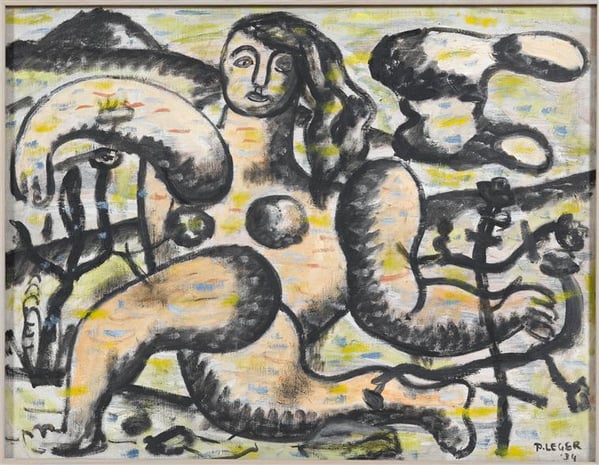
Fernand Léger’s The Kneeling Woman exemplifies a distinctive branch of Cubism—one that diverges from the analytical fragmentation of Picasso and Braque toward a more robust, industrial, and color-driven aesthetic. Painted at the height of his “mechanical period,” this portrait demonstrates Léger’s obsessive interest in transforming the human figure into a dynamic assembly of cylinder-like volumes, cones, and truncated spheres, as if built from factory parts.
Significance Within Cubism:
- Tubular Forms and Modernity: Unlike the faceted, shadowy planes of Analytic Cubism, Léger boldy outlines the kneeling woman’s body in smooth, rounded, pipe-like segments—arms, torso, and head reduced to interlocking mechanical elements. This “tubism” (a term sometimes applied to Léger) directly connects Cubism’s geometric language to the machine age, celebrating the sleek, engineered beauty of contemporary life.
- Color as Structure: While early Cubism often muted color to focus on form, Léger attacks the portrait with primary reds, yellows, blues, and stark blacks. These flat, unmodulated hues are locked into the composition by thick black contours, creating a stained-glass or poster-like intensity. The kneeling pose—traditionally submissive in art—is here reimagined as a powerful, stable geometric force.
- Monumentality and Abstraction: The figure is simplified to the point where anatomy becomes a set of abstract signs: a circle for the head, a triangle for the lifted knee, a cylinder for the arm. Yet Léger retains the portrait’s iconic presence, proving Cubism could produce not just disassembled views but newly coherent, monumental images—a significant step toward the Purism and Figurative Abstraction of the 1920s.
Why It Matters:
The Kneeling Woman stands as a pivotal example of how Cubism evolved from intellectual analysis to a more visceral, popular, and object-oriented style. Léger’s fusion of Cubist geometry with the aesthetics of machinery, signage, and mass production prefigures Pop Art and industrial design. In this portrait, the woman is not merely fragmented; she is reassembled as a powerful emblem of modern strength—kneeling, yet resolutely solid.
Museum / Gallery
Visually similar
20 works with related composition and palette
Tři Grácie
Emil Filla
Te veo
Alfredo Teofilo Cuello
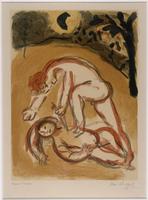
Cain and Abel
Marc Chagall
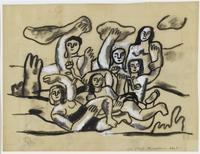
Study for The Bathers
Fernand Leger
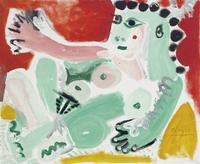
Seated Nude supported by Cushions (Jacqueline)
Pablo Picasso
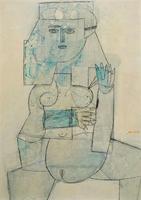
Figure
Jean David
Deux femmes au repos
Le Corbusier
Russian Venus
Billy Childish
Acrobate VII
Georges Rouault
Large nude in red armchair
Pablo Picasso
Studio Interior with Guitar Case
Robert De Niro, Sr.
Removal
Andre Masson
Nude
Marc Chagall
Opera Figures
Ding Yanyong
Female nude in the garden
Pablo Picasso
The Bathers
Fernand Leger
In the Bath
Beatrice Wood
Femme nue
Pablo Picasso
Three Women
Robert De Niro, Sr.
Echoes 1
Judith Godwin