Expertenanalyse zu Fernand Legers The two women bouquet
Stil: Cubism · Genre: portrait
Expert Analysis of Fernand Léger's "The Two Women Bouquet" (c. 1921)
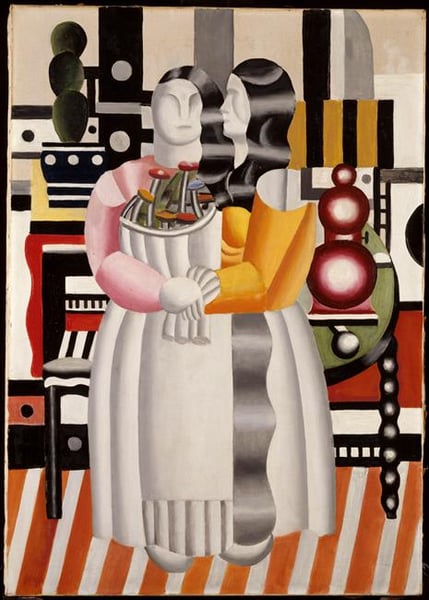
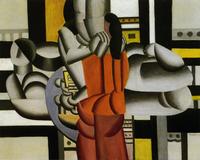
Within the canon of Cubism, Fernand Léger carved a distinctive path—one that diverged from the fragmented, monochromatic analytics of Picasso and Braque and instead embraced a bold, machinist vision of modern life. "The Two Women Bouquet" exemplifies Léger's mature "mechanical" Cubist style, where the human figure and still life are fused into a dynamic, industrial-age composition.
What makes this work significant:
-
Tubular & Machine-Aesthetic Forms – Unlike the faceted planes of early Cubism, Léger reduces the two women and the bouquet to cylindrical, conical, and spherical volumes. Their bodies appear assembled from pipes, gears, and industrial parts—a deliberate celebration of the machine age. This "tubism" gives the portrait a sculptural, almost robotic monumentality.
-
Bold, Unmodulated Colors – Léger abandons Cubism's typical earthy palette for saturated primaries (red, yellow, blue) and stark blacks. These colors are applied in flat, clearly delineated areas, creating a poster-like clarity. The contrast between the cool blue of the women’s forms and the warm reds/oranges of the bouquet suggests an energetic tension between the human and the organic.
-
Synthesis of Figure and Still Life – The bouquet is not a separate element but is interlocked with the women’s bodies, their arms resembling stems or vase-like curves. This compositional fusion demonstrates Léger’s belief that all objects—human, floral, mechanical—share a common plastic language of volume and line.
-
Genres Blurred – Though classed as a portrait, the work functions as a modern vanitas: the women are depersonalized, their faces schematic ovals lacking individual identity. They become archetypes of the "new woman" of the 1920s, while the bouquet signals vitality and yet an almost sterile perfection.
In context:
Painted at the height of the "Rappel à l'ordre" (return to order) after World War I, "The Two Women Bouquet" reflects Léger’s desire to rebuild art through clear, rational forms. It stands as a key bridge between Cubism’s intellectual deconstruction and the emerging Purist aesthetic—prefiguring the streamlined, functionalist design of the Art Deco era. The work’s significance lies in its bold assertion that the human figure could be rendered with the same crisp, industrial logic as a machine part, without losing pictorial harmony.
Museum / Gallery
Visuell ähnlich
20 Werke mit ähnlicher Komposition und Farbpalette
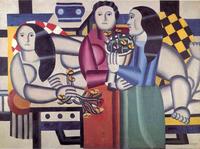
Three women with flowers
Fernand Leger
La dame au chat et à la théière
Le Corbusier
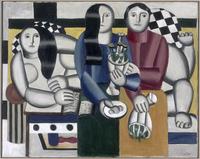
Trouville
Fernand Leger
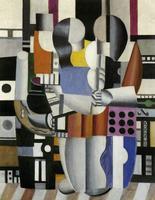
Three figures
Fernand Leger
Untitled
Emiliano Di Cavalcanti
V sadě
Josef Capek
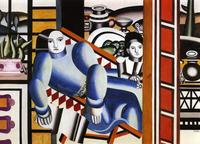
The Woman and the child
Fernand Leger
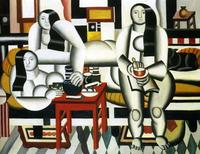
The Breakfast
Fernand Leger
Scheiber Hugó Bubifrizurás Hölgy Bárban, Gouache, Pasztell, Papírlemez, 67,5x50cm
Scheiber Hugó
Děvče v růžových šatech
Josef Capek
Popular song bird and Brazil
Amadeo de Souza-Cardoso
Les Présences
Leopold Survage
Girl Reading
Georges Valmier
Two women with the toilet, final state
Fernand Leger
Scheiber Hugó ,testvérek
Scheiber Hugó
Harlequin
Juan Gris
Berlini Kabaré
Bela Kadar
Seated Woman
Maria Blanchard
Three women with the still life
Fernand Leger
Scheiber Hugó Bohóclány.
Scheiber Hugó