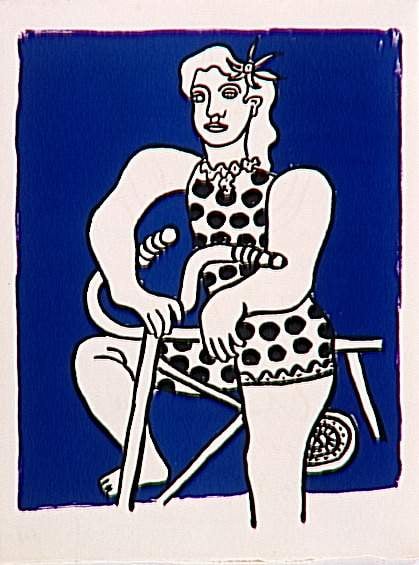
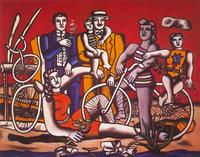
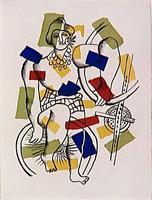
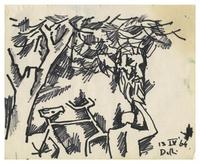
The album “Circus” by Fernand Léger is a notable departure from his signature machine-age Cubism, embracing Naïve Art (Primitivism) in a series of sketches and studies. Its significance lies in how Léger intentionally simplifies form and perspective to evoke the raw, spontaneous energy of the circus—a subject that allows him to strip away industrial geometry and return to elemental line, flat color, and childlike directness. As a sketch and study, the work reveals Léger’s process of distilling movement and spectacle into basic visual rhythms, bridging his earlier mechanomorphic style with a more universal, folk-inflected language. Within the period of Primitivism, this album stands out because it applies that aesthetic not to “exotic” or tribal imagery but to a familiar modern entertainment, thereby questioning the boundaries between high art and popular culture while celebrating the vitality of pure visual sensation.