Analisi esperta di The album "Circus" di Fernand Leger
Stile: Purism · Genere: sketch and study
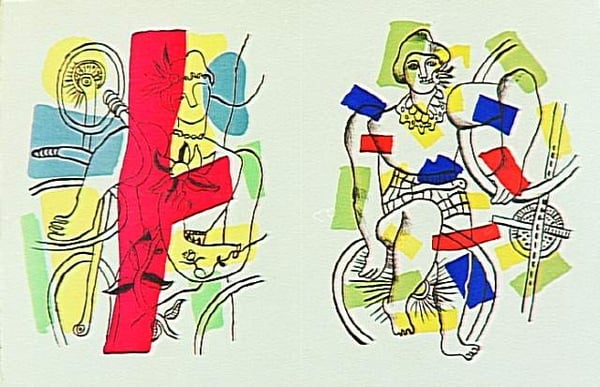
Expert Analysis: "The album 'Circus'" by Fernand Léger
Style/Period Context
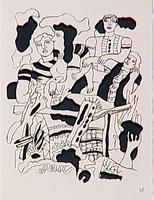
Fernand Léger’s “Circus” album, created within the Purist movement (c. 1918–1925), represents a pivotal fusion of Cubist-derived geometry with the ordered, machine-age clarity that Purism championed. Purism, led by Amédée Ozenfant and Le Corbusier, rejected the decorative excesses of Cubism in favor of clean, precise forms and a rational, almost industrial aesthetic. Léger, though not a strict Purist theorist, shared this devotion to “machine beauty” and the harmonious arrangement of volumes.
Significance of the Work
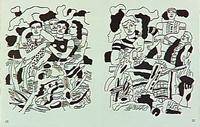
The “Circus” album is significant because it demonstrates Léger’s unique ability to translate the energy of popular entertainment into the disciplined language of Purism. While many Purist works depicted static, everyday objects (bottles, guitars, architectural elements), Léger turned to the dynamic, human spectacle of the circus. In these sketches and studies—the genre implies preparatory, spontaneous investigations—he captures the rhythm, motion, and vibrant costume of circus performers through simplified, tubular forms and bold color contrasts.
Key Artistic Contributions
- Integration of Movement with Order: Léger’s circus figures are broken down into cylinders, cones, and spheres, yet they retain a sense of acrobatic tension and flow. This reconciles Purism’s insistence on static clarity with the kinetic excitement of the performance.
- Celebration of Modern Life: Léger saw the circus as a microcosm of the modern world—a spectacle of mechanized repetition (acts, lights, music) and human skill. The “Circus” album reflects his belief that art should engage with contemporary urban experience, not retreat into tradition.
- Transitional Nature: These studies bridge Léger’s earlier mechanomorphic works (e.g., The City, 1919) and his later, more monumental circus paintings (e.g., The Great Parade, 1954). The album’s sketchy quality reveals his process of distilling complex scenes into Purist forms, making it a valuable document of his creative evolution.
Why It Matters
The “Circus” album stands as a reminder that Purism, often seen as austere, could embrace playfulness and popular culture. Léger proves that geometric abstraction need not be cold—it can pulse with the color and movement of the big top. This work thus expands Purism’s emotional range, affirming Léger’s role as a modernist who celebrated both the machine and the human body in joyous synthesis.
Museum / Gallery
Visivamente simili
20 opere con composizione e palette affini
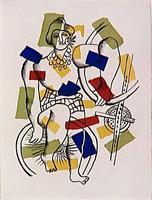
The album "Circus"
Fernand Leger
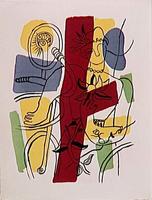
The album "Circus"
Fernand Leger
The album "Circus"
Fernand Leger
The album "Circus"
Fernand Leger
Untitled
Vasile Kazar
Untitled
Jack Tworkov
Untitled
Vasile Kazar
Untitled
Vasile Kazar
Female Figure
M.F. Husain
Une Pierre, deux passages (One Stone, Two Passes)
Pierre Alechinsky
The Prophet and Herodias
Willi Baumeister
Untitled (Abstraction)
Betty Parsons
Femme et mains
Le Corbusier
Vajda Lajos Dposition from the Cross, Pencil on Paper, 44x30cm
Vajda Lajos
Seated Woman
Henri Laurens
Le Prisonnier
Charles Lapicque
Prostrating Figure
Anne Ryan
Untitled
Vasile Kazar
Animated Slope
Willi Baumeister
One Stone, Two Passes
Pierre Alechinsky