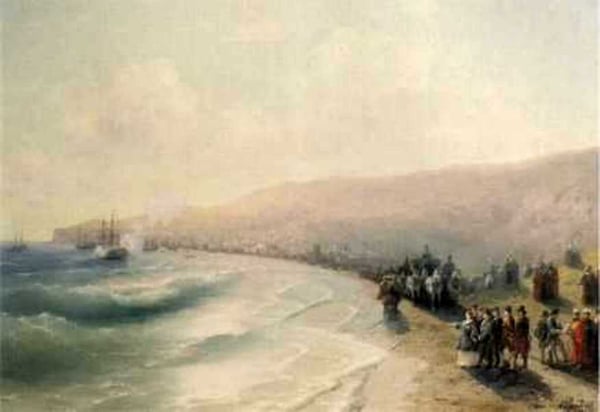
Analisi esperta di Arrival Catherine the Second to Pheodosiya di Ivan Aivazovsky
Stile: Romanticism · Genere: landscape
Expert Analysis: "Arrival Catherine the Second to Pheodosiya" by Ivan Aivazovsky
This work, painted in the Romantic style, exemplifies Aivazovsky’s signature fusion of historical pageantry with sublime landscape. As a landscape genre piece, it does not merely record an event but elevates it into a dramatic, emotional encounter between human ambition and the vast forces of nature.
Significance within Romanticism
Aivazovsky, the preeminent Russian marine painter, here demonstrates Romanticism’s core tenets: awe before nature’s majesty, and the ennobling of national history through emotion. The arrival of Empress Catherine II at the Crimean port of Feodosia (then spelled Pheodosiya) is not a dry documentary scene. Instead, the artist uses the sea, sky, and light to amplify the significance of the moment.
- Atmospheric Drama: The sky is likely rendered with Aivazovsky’s celebrated mastery of light and atmosphere—perhaps a golden or tempestuous horizon that frames the imperial fleet. The sea, his constant subject, is not a passive backdrop but a living, majestic force that both honors and dwarfs the imperial procession.
- Natural Sublime: Romanticism prized the sublime—a feeling of overwhelming grandeur tinged with terror. The vastness of the sea and sky relative to the ships and figures creates this effect. The viewer senses the power of nature, even as human civilization (Catherine’s court) asserts its presence.
- Patriotic Romanticism: The choice of subject reflects Romantic nationalism: celebrating a pivotal moment in Russia’s expansion into the Black Sea region. Aivazovsky, himself of Armenian descent and based in Feodosia, likely imbues the scene with personal and civic pride, portraying Catherine as a figure of Enlightenment order arriving to claim a romantic, untamed coastline.
Why It Stands Out
While many of Aivazovsky’s most famous works (The Ninth Wave, The Black Sea) focus on pure seascape drama, this painting integrates historical narrative with landscape. It demonstrates how Romantic landscape painters could serve as visual chroniclers of empire, using the natural world to frame and amplify political events. The work is significant as a prime example of how Russian Romanticism blended Western European sublime aesthetics with distinctly Russian historical and geographical identity—making the arrival of Catherine a moment of both earthly power and cosmic harmony.
Visivamente simili
20 opere con composizione e palette affini
Karaiskakis, Faliro
Konstantinos Volanakis
Mending Nets, Brittany
Edward E. Simmons
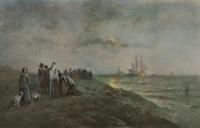
Embarkation of the Pilgrims from Southampton, 1620
Edward Moran

Pushkin and Countess Raevskaya by the sea near Gurzuf and Partenit
Ivan Aivazovsky
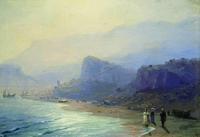
Pushkin and Raevskaya in Gurzuf
Ivan Aivazovsky

Sheep which forced by storm to the sea
Ivan Aivazovsky
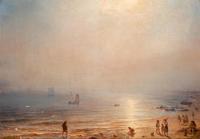
Fisherfolk on a Beach
Theodore Gudin
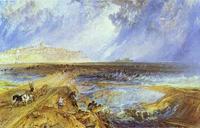
Rye, Sussex
J.M.W. Turner

Crete
Ivan Aivazovsky
Capture Turkish kocherma
Ivan Aivazovsky
Bargaining for the Catch
William Shayer
Scarborough Town and Castle. Morning.Boys Catching Crabs
J.M.W. Turner

Pushkin at the Waters Edge
Ivan Aivazovsky
Tempest above Evpatoriya
Ivan Aivazovsky
Le Depart Du Bateau De Sauvetage
Hendrik Willem Mesdag
Rhyl Sands
David Cox
Morning on a sea
Ivan Aivazovsky
On the Island of Crete
Ivan Aivazovsky
Ulverston Sands
David Cox
Hastings: Boats Making the Shore in a Breeze
John James Chalon