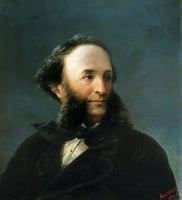
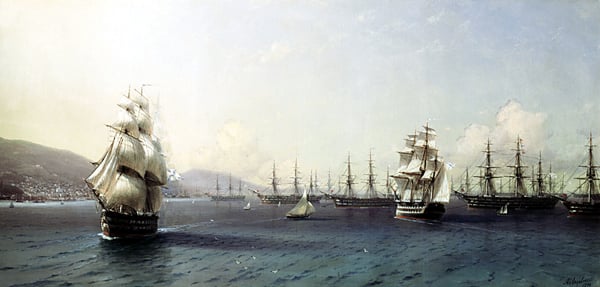
The Black Sea Fleet in Feodosia Bay before the Crimean War
詳細
Ivan Aivazovsky の The Black Sea Fleet in Feodosia Bay before the Crimean War の専門的な分析
スタイル:Romanticism · ジャンル:marina
Expert Analysis: "The Black Sea Fleet in Feodosia Bay before the Crimean War" by Ivan Aivazovsky
As a prime exemplar of Romanticism and the marina genre, Ivan Aivazovsky's painting holds its significance in three key dimensions: its masterful capture of nature's sublime power, its precise historical embedding, and its celebration of national maritime identity.
Romantic Sublime and Technical Virtuosity
Aivazovsky was the preeminent Romantic seascape painter of the 19th century, and this work demonstrates his signature ability to infuse a factual scene with emotional intensity. The composition juxtaposes the ordered, man-made silhouette of the fleet against the untamed, shimmering expanse of the Black Sea. The turbulent sky—with rolling clouds pierced by shafts of light—and the restless, foam-flecked waves evoke the awe-inspiring, often dangerous majesty of nature. This is quintessential Romanticism: human ambition and military might are dwarfed by the elemental forces of wind and water, yet they persevere, embodying the Romantic heroism of facing the vast unknown. Aivazovsky’s luminous palette and virtuosic handling of light on water—transparent, almost ethereal—create a dreamlike yet palpable atmosphere, elevating a topographical view into a meditation on transience and grandeur.
Historical Pivot and Patriotic Undertone
The title explicitly anchors the scene to the moment before the Crimean War (1853–1856), a conflict that would devastate the Russian Black Sea Fleet at the Battle of Sinope and during the Siege of Sevastopol. This temporal framing imbues the painting with poignant foreshadowing: the calm, majestic assembly of ships in Feodosia Bay—Aivazovsky’s own hometown—becomes a visual elegy. The fleet appears resplendent and powerful, yet the viewer, aware of history, sees it as doomed. This blend of Romantic nostalgia and patriotic lament is a hallmark of Aivazovsky’s mature work. He was not merely a chronicler of naval pageantry; he transformed the fleet into a symbol of Russian glory and impending tragedy, making the canvas a meditation on the fragility of human achievement against the currents of history.
Significance within the Marina Genre
Within the specific tradition of the marina, Aivazovsky stands apart for his insistence on verisimilitude combined with poetic license. Here, the precise rendering of ship types, anchorages, and bay geography serves the larger Romantic goal of emotional truth. The painting’s significance lies in how it transcends documentary function: the fleet is not a static inventory but a living, breathing organism caught in a liminal moment of peace before storm—both literal and metaphorical. This ability to weave topographical accuracy, historical reference, and sublime emotion into a single, unified vision is what places Aivazovsky’s work among the highest achievements of the Romantic marine tradition.
Museum / Gallery
視覚的に類似
構図やパレットが近い作品 20 件
Piraeus
Hubert Sattler
First Recognition of the American Flag by a Foreign Government
Edward Moran
The battle of fregate Flora against Turkish steamships near Pitsunda November, 11 1853
Alexey Bogolyubov
The Capture of the 'Petit Rodeur'
Eugene Boudin
Parade of the Black Sea Fleet
Ivan Aivazovsky
Capturing of Swedish 44 gun frigate Venus by Russian 22 gun cutter Merkuriy of June 1, 1789
Alexey Bogolyubov
Sunset at the seashore
Konstantinos Volanakis
HMS 'Enchantress' in the River Dart
Charles Martin Powell
Summer Morning in New York
Edward Moran
The Port of New Bedford from Crow Island
William Bradford
East Indiaman Warley
Robert Salmon
Battle of Krasnaya Gorka
Alexey Bogolyubov
The Ship Isabella at Sea
John Wilson Carmichael
Combat De La Poursuivante Contre L'hercule, 1803 ("fight of the Pou
Louis-Philippe Crépin
Russian-Turkish Sea Battle of Sinop on 18th November 1853
Ivan Aivazovsky
Ship off the Coast
Ivan Aivazovsky
Derek Gardner
Derek Gardner
THE FINAL BROADSIDE
Nicholas Pocock
Frigate on calm waters
Ioannis Altamouras
American Cutter at a Foreign Port
Thomas Birch