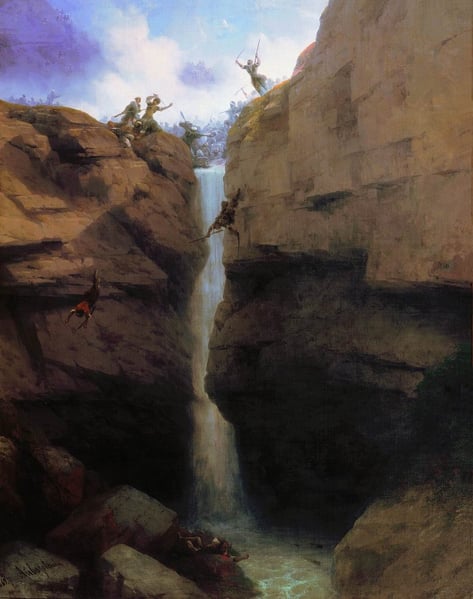
Expert analysis of Ivan Aivazovsky’s Clash soldiers with murids on Gunib
Style: Romanticism · Genre: landscape
Expert Art Historical Analysis
Ivan Aivazovsky’s Clash soldiers with murids on Gunib (c. 1869) stands as a powerful exemplar of Romanticism in landscape painting, merging the genre’s hallmark emotional intensity and sublime natural drama with a specific historical narrative from the Caucasian War (1817–1864). While Aivazovsky is most celebrated for his luminous seascapes, this work demonstrates his mastery in using landscape itself as a protagonist—transforming a military skirmish into a meditation on nature’s overwhelming force and human conflict’s fleeting drama.
Significance within Romanticism and Landscape Genre:
-
Sublime Landscape as Active Participant: Romantic landscape art often elevates nature to a sublime, almost threatening presence. Here, the mountainous terrain of Gunib—a rocky stronghold in Dagestan—is rendered with dramatic chiaroscuro and turbulent atmospheric effects. The clash between Russian soldiers (likely Imperial troops) and Murid fighters (Islamic resistance fighters led by Imam Shamil) is dwarfed by the towering cliffs and swirling clouds, emphasizing the insignificance of human struggle against the ancient, indifferent landscape. This aligns with Romantic ideals of the sublime, where awe and terror merge.
-
Dynamic Light and Atmosphere: Aivazovsky applies his celebrated skill in capturing light—usually seen in his marine pieces—to the mountainous setting. Ragged clouds, patches of sunlight illuminating the battlefield, and deep shadows create a sense of fleeting, charged moment. The sky’s dramatic glow, typical of Romanticism, heightens the emotional stakes, suggesting both the heroism and tragedy of the confrontation.
-
Historical Specificity Within a Universal Theme: The title references the 1859 siege of Gunib, where Imam Shamil was finally captured. Yet Aivazovsky does not focus on portraiture or detailed military tactics; instead, he subsumes the historical event into a landscape of vast scale. This approach distinguishes the work: it is not a documentary battle painting but a Romantic landscape that uses history to explore themes of resistance, fate, and nature’s dominance.
-
Contribution to Aivazovsky’s Oeuvre: Though primarily a marine painter, Aivazovsky’s foray into Caucasian battle landscapes—part of a series commissioned after the war—bridges his technical brilliance with nationalistic and orientalist themes popular in 19th-century Russia. The painting’s significance lies in how it adapts the Romantic landscape vocabulary (sublime mountains, stormy skies, isolated human figures) to a conflict that resonated deeply in Russian imperial consciousness.
In sum, Clash soldiers with murids on Gunib is significant because it exemplifies Romanticism’s core tenets: nature as an overwhelming, emotive force; the use of dramatic light and atmosphere to heighten emotional response; and the integration of historical narrative into a landscape that transcends mere documentation. Aivazovsky elevates a local skirmish into a universal Romantic tableau, where the land itself becomes the central, eternal character.
Visually similar
20 works with related composition and palette
Bash Bish Falls
John Frederick Kensett
Landscape with Stag
Gustave Courbet
Subiaco
Penry Williams
Gordale Scar
James Ward
Waterfall in the Bern Highlands
Joseph Anton Koch
Gordale Scar (A View of Gordale, in the Manor of East Malham in Craven, Yorkshire, the Property of Lord Ribblesdale)
James Ward
Salvator Rosa Sketching the Banditi
Thomas Moran
Study for 'Gordale Scar'
James Ward
Cascade, Rockland County (Ramapo) NY
David Johnson
A Waterfall
John Singer Sargent
Eionon Garn on the Perddyn or Ysgwd or Scwd Fall, Neath Valley
Penry Williams
Falls at Toltec Gorge
Thomas Moran
Schlucht Im Walde
Joseph Anton Koch
A Mountain Stream
Thomas Moran
Sgwd yr Henryd, Vale of Neath
Penry Williams
Rock arch in the Uttewalder Grund
Caspar David Friedrich
Waterfall between the rocks
Michele Cammarano
View of the Waterfalls at Tivoli
Jean-Joseph-Xavier Bidauld
Expulsion. Moon and Firelight
Thomas Cole
The Mountain Torrent
Francis Danby