Expert analysis of Ivan Aivazovsky’s Darial Gorge
Style: Romanticism · Genre: landscape
Expert Analysis: Darial Gorge by Ivan Aivazovsky
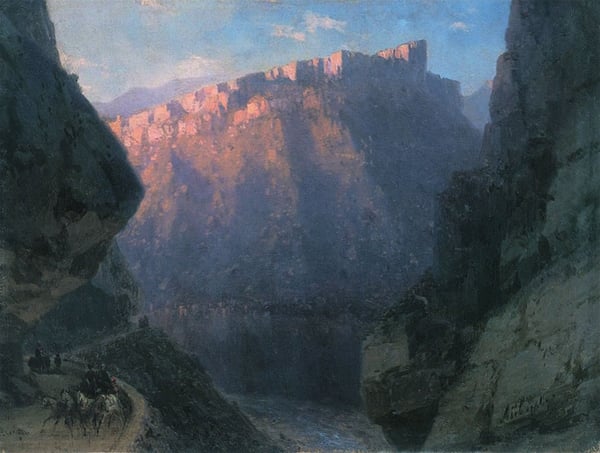
Within the canon of Romanticism, Darial Gorge stands as a striking departure from Aivazovsky’s celebrated marine subjects, yet it embodies the movement’s core tenets: the sublime, the overwhelming power of nature, and the emotional resonance of wild, untamed landscapes. The painting’s significance lies in its masterful translation of Romantic ideals into a terrestrial setting, using the dramatic topography of the Caucasus to evoke awe and terror—a hallmark of the Romantic sublime.
Romanticism and the Sublime Landscape
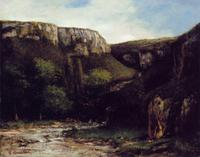
Romantic landscape painting often sought to dwarf the human figure before nature’s grandeur. In Darial Gorge, Aivazovsky captures this by depicting the sheer, jagged cliffs of the legendary ravine, likely with a rushing river cutting through the abyss. The composition would emphasize verticality and depth, drawing the viewer’s eye into the chasm where light and shadow clash—a classic Romantic device to suggest both danger and beauty. The gorge’s historical reputation as a treacherous mountain pass aligns perfectly with Romanticism’s fascination with uncontrollable nature.
Aivazovsky’s Technical and Thematic Reach
While Aivazovsky is renowned for his luminous seascapes, Darial Gorge demonstrates his versatility. The work likely employs the same dramatic chiaroscuro and atmospheric perspective he used for oceans—here applied to stone and sky. Silvery mist, fractured sunlight, and the contrast of dark rock faces against a glowing horizon would amplify the scene’s emotional intensity. This shift from sea to stone is itself significant, proving that Aivazovsky could dominate any Romantic landscape genre, not just maritime views.
Cultural and Aesthetic Significance
The Darial Gorge was a literary and historical symbol of the East–West divide, celebrated in Romantic poetry (e.g., Lermontov’s The Demon). Aivazovsky’s painting thus participates in a larger cultural dialogue, visualizing the sublime as a force that transcends geography. By choosing this specific location, the artist aligns his work with Romanticism’s obsession with exotic, awe-inspiring frontiers.
In summary, Darial Gorge is significant because it expands Aivazovsky’s mastery beyond seascapes, proving that Romanticism’s emotional power—whether in water or stone—could be channeled through a single, breathtaking vista.
Visually similar
20 works with related composition and palette
The Daryal canyon
Ivan Aivazovsky
Darial Gorge. Moon night
Ivan Aivazovsky
The gorge of the Rocky Mountains
Vasily Polenov
Travellers in the mountains
Carlo Ademollo
The Caucasus
Ivan Aivazovsky

Darial Gorge
Ivan Aivazovsky
View of Gunib
Ivan Aivazovsky
Acoma Pueblo
Thomas Moran
The Challange
David Cox

The Daryal canyon
Ivan Aivazovsky
The Southern Entrance to Almannagiaa near Thingvalla in Iceland
Christian Ezdorf
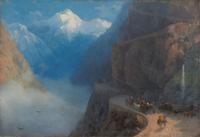
From Mleta to Gudauri
Ivan Aivazovsky
Mountain Village Gunib in Daghestan View from the East
Ivan Aivazovsky

A Side Canyon
Thomas Moran
Pass of Llanberis, Caernarvonshire, Wales
David Cox
Phaëton in a Thunderstorm
Julius Caesar Ibbetson

Coconino Pines and Cliff Arizona
Thomas Moran

Valley of the Vaucluse
Thomas Cole
Mountain Landscape with Lovers
Carl Spitzweg
The Gorge
Gustave Courbet