Expert Analysis of "Evening in the Crimea" by Ivan Aivazovsky
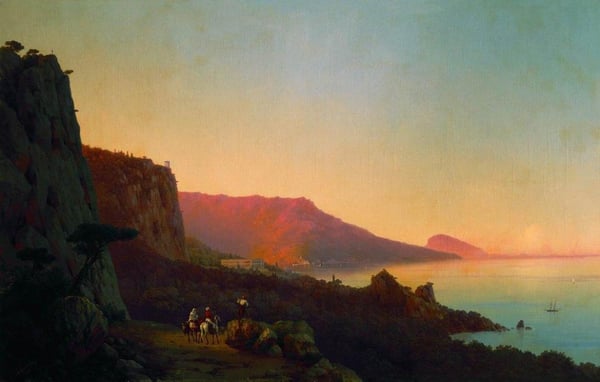
As a Romantic landscape, Aivazovsky’s Evening in the Crimea exemplifies the movement’s fascination with the sublime power and emotional resonance of nature. The painting captures a transient moment of twilight—a time when the boundary between day and night softens, allowing the artist to explore dramatic contrasts of light and shadow.
What makes this work significant within Romanticism is Aivazovsky’s virtuosic handling of atmosphere. The Crimean coastline, a recurring subject in his oeuvre, is transformed into a stage for luminous effects: the fading daylight reflected on the sea, the warm hues of the setting sun bleeding into a violet sky, and the subtle interplay of cool moonlight beginning to assert itself. This mastery of chiaroscuro and color temperature heightens the painting’s emotional intensity, inviting viewers to experience both the tranquility and the vast, untamed spirit of the Black Sea.
Within the genre of landscape, Aivazovsky elevates the scene beyond mere topography. The composition—likely featuring a low horizon, vast sky, and still or gently rippling water—echoes the Romantic ideal of nature as a mirror for human emotion. The painting’s significance lies in its ability to evoke a sense of solitary wonder, a hallmark of Romanticism, while showcasing Aivazovsky’s unparalleled skill in rendering the fleeting beauty of coastal light.