
Expertenanalyse zu Ivan Aivazovskys Lunar night on a sea
Stil: Romanticism · Genre: marina
Expert Analysis of "Lunar night on a sea" by Ivan Aivazovsky
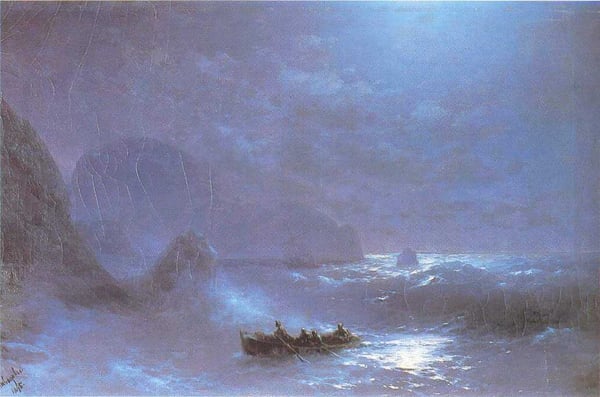
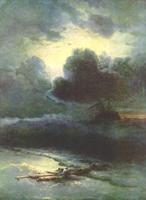
This work stands as a quintessential example of Romantic marina painting, where Ivan Aivazovsky masterfully harnesses the sublime power of nature through a nocturnal seascape. The painting’s significance lies in its embodiment of Romanticism’s core preoccupations: the overwhelming majesty of the natural world, the emotional resonance of light and shadow, and the evocation of human insignificance before the vastness of the sea.
Stylistic Significance within Romanticism
Aivazovsky, a titan of Romantic marine art, here transforms the simple subject of a moonlit sea into a dramatic theater of atmospherics. The "lunar night" permits a contrast between the cold, silvery glow of the moon and the deep, almost velvety darkness of the water. This chiaroscuro effect is not mere decoration but a Romantic device: it heightens the viewer’s sense of awe and mystery. The moonlight becomes a protagonist, illuminating the restless waves and hinting at an unseen horizon, a classic Romantic gesture toward the infinite and the unknowable.
Genre Mastery: The Marina as Emotional Landscape
As a marina, the painting goes beyond topographical record. Aivazovsky uses the sea — with its rhythmic, glistening swells and the scattering of light across the surface — to evoke a mood of contemplative solitude. The absence of human figures or vessels (based on the given information) further amplifies the Romantic ideal of nature untamed and indifferent. The painting’s significance also lies in its technical bravura: the translucent layers of oil paint that simulate the moon’s reflection, the fluid brushstrokes that capture the sea’s perpetual motion. This virtuosity aligns with Aivazovsky’s reputation for making the sea feel alive, breathing, and eternal.
Why It Matters
In the context of 19th-century Romanticism, "Lunar night on a sea" exemplifies how the movement used elemental forces — night, water, light — to probe human emotion. Aivazovsky’s achievement is to turn a specific atmospheric condition into a universal experience of the sublime: the viewer is invited to feel both the beauty and the terror of the ocean’s endless expanse. This painting is significant not merely as a beautiful seascape but as a profound meditation on nature’s power, a hallmark of Romantic artistic expression.
Visuell ähnlich
20 Werke mit ähnlicher Komposition und Farbpalette
Island of Patmos
Ivan Aivazovsky
Sunset at Sea
Ivan Aivazovsky
Napoleon on island of St. Helen
Ivan Aivazovsky
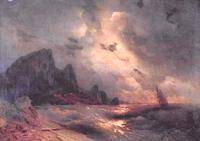
Sea
Ivan Aivazovsky
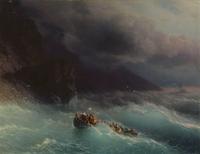
The Shipwreck on Black Sea
Ivan Aivazovsky
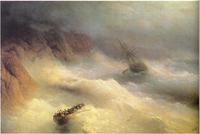
Tempest by cape Aiya
Ivan Aivazovsky
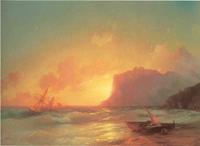
The Sea. Koktebel.
Ivan Aivazovsky
Cristofor Columb
Ivan Aivazovsky
On the storm
Ivan Aivazovsky
Sea View
Ivan Aivazovsky
The Shipwreck
Ivan Aivazovsky
Tempest. Sunset
Ivan Aivazovsky
The Shipwreck
Ivan Aivazovsky
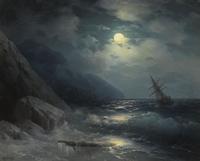
Moonlit Landscape with a Ship
Ivan Aivazovsky
Shipwreck on a Rocky Shore
Ivan Aivazovsky
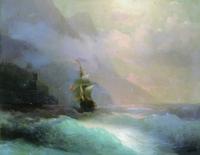
Seascape
Ivan Aivazovsky
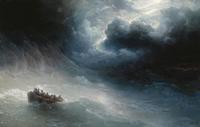
The Wrath Of The Seas
Ivan Aivazovsky
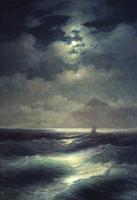
Sea view by Moonlight
Ivan Aivazovsky
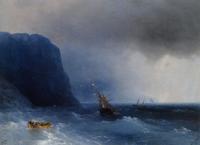
The Survivors
Ivan Aivazovsky
Thunderstorm
Ivan Aivazovsky