
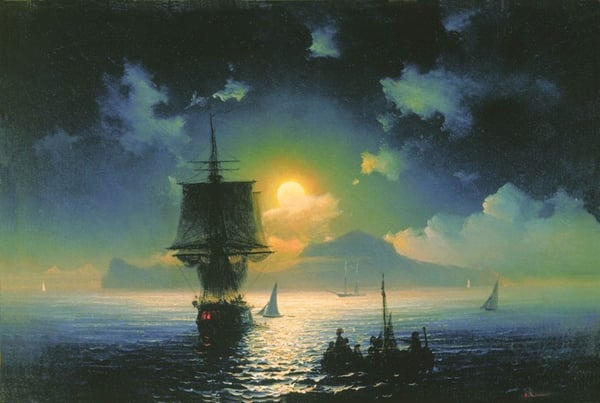
Expertenanalyse zu Ivan Aivazovskys Lunar night on Capri
Stil: Romanticism · Genre: marina
Expert Analysis: "Lunar night on Capri" by Ivan Aivazovsky
Ivan Aivazovsky (1817–1900) is celebrated as one of the greatest masters of the Romantic marine landscape. Lunar night on Capri exemplifies his signature ability to merge the sublime power of nature with a poetic, almost theatrical sense of light. Painted in the Romantic style, the work belongs to the marina genre—a specialization Aivazovsky elevated to an art form through his virtuosic rendering of water, sky, and atmospheric effects.
Significance within Romanticism and the Marina Genre
-
Mastery of Luminosity and Atmosphere: The central subject is not Capri itself but the moon’s reflection on the sea. Aivazovsky achieves a near-supernatural luminosity by layering translucent glazes, making the moonlight appear to radiate from within the canvas. This technique—honing the Romantic preoccupation with light as an emotional and spiritual force—gives the scene a hushed, nocturnal reverence.
-
Sublime Contrast: Romanticism prized the contrast between the vast, untamed ocean and the small, transient human presence. In Lunar night on Capri, the dark silhouettes of boats or coastal structures (if present) are dwarfed by the infinite expanse of water and sky. The moon’s cold, silvery glow versus the deep indigo of the night sky heightens the sense of solitude and awe—a core Romantic response to nature.
-
Aivazovsky’s Signature Technique: Unlike many marine painters, Aivazovsky rarely used preliminary drawings; he painted directly from memory, capturing the fleeting effects of light and wind. His brushwork here combines broad, fluid strokes for the water’s surface with delicate, precise touches for the moon’s shimmer. This spontaneity lends the scene an impressionistic freshness while retaining Romantic drama.
-
Capri as a Romantic Trope: The Isle of Capri—with its dramatic cliffs and Mediterranean light—was a favored subject for 19th-century artists seeking the picturesque and the exotic. Aivazovsky’s choice situates the work within a broader Romantic fascination with Italy as a land of timeless beauty and melancholic ruin. However, he transforms the locale into a universal symbol of the sublime night sea.
Conclusion
Lunar night on Capri is significant as a quintessential example of Aivazovsky’s Romantic marinism: it demonstrates his unparalleled ability to evoke mood through light, his reverence for nature’s majesty, and his technical brilliance in rendering the ever-changing sea. The painting invites viewers to lose themselves in the silent dialogue between moonlight and water—a moment of serene grandeur that defines the Romantic spirit.
Museum / Gallery
Visuell ähnlich
20 Werke mit ähnlicher Komposition und Farbpalette
The Harbor At Odessa On The Black Sea
Ivan Aivazovsky
Gibraltar by Night
Ivan Aivazovsky
Moonlight on the Norwegian coast
Knud Baade
Turkish steamships attack 44 gun fregate Flora
Alexey Bogolyubov
Lunar night
Ivan Aivazovsky
Crimea
Ivan Aivazovsky
Calm Sea
Ivan Aivazovsky
The Brig Mercury in Moonlight
Ivan Aivazovsky
GALLEON
Montague Dawson
Morning at Sea
Ivan Aivazovsky
Sea view
Ivan Aivazovsky
Ship at Sunset off Cap Martin
Ivan Aivazovsky
Ships at Night
Edward Moran
After the storm
Ivan Aivazovsky
Battle of Chesma
Ivan Aivazovsky
Sea on a moonlit night
Ivan Aivazovsky
View of the sea at night
Ivan Aivazovsky
The Brig Mercury Encounter After Defeating Two Turkish Ships of the Russian Squadron
Ivan Aivazovsky
Frigate on calm waters
Ioannis Altamouras
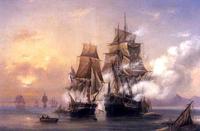
Capturing of Swedish 44 gun frigate Venus by Russian 22 gun cutter Merkuriy of June 1, 1789
Alexey Bogolyubov