Expert analysis of Ivan Aivazovsky’s Night at the Rodos island
Style: Romanticism · Genre: landscape
Expert Analysis: "Night at the Rodos Island" by Ivan Aivazovsky
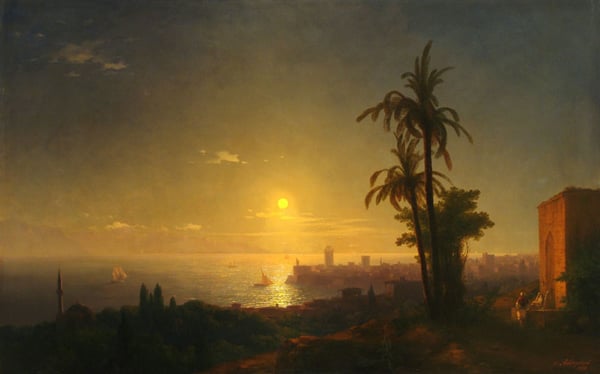
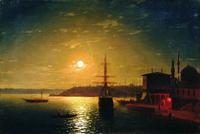
Ivan Aivazovsky, the preeminent Russian Romantic painter of the 19th century, is celebrated for his unparalleled ability to capture the sublime power and transient beauty of the sea. In "Night at the Rodos Island" —a Romantic landscape—Aivazovsky demonstrates the very qualities that define his significance: a masterful command of light, atmosphere, and emotional resonance.
Central Significance within Romanticism
This painting exemplifies the Romantic fascination with the sublime—the awe-inspiring, often overwhelming force of nature. Aivazovsky’s nocturnal seascape transforms the island of Rhodes (Rodos) into a stage for a dramatic interplay between the dark, churning sea and the luminous, silvery glow of the moon. The moon, partially veiled by drifting clouds, becomes the sole source of illumination, casting a ghostly path across the water. This use of chiaroscuro and luminism is characteristic of Aivazovsky’s technique; he layers translucent glazes to create an almost tangible sense of light reflecting off waves, mist, and the ancient shoreline.
Technical Mastery
Aivazovsky’s plein-air sensibility is evident in the fluid, atmospheric brushwork. The sky is a study in shifting tones—from deep ultramarine near the horizon to inky indigo at the zenith—while the sea ripples with reflections that break into delicate highlights. The distant silhouette of Rhodes’ hills and medieval fortifications grounds the composition, anchoring the cosmic drama to a specific, historically resonant location. The artist’s ability to render moonlight on water with such ethereal precision was unmatched in his era; he famously said, “For me, the sea is my life,” and this painting captures both its tranquility and its latent danger.
Emotional and Symbolic Weight
“Night at the Rodos Island” evokes a mood of solitude and introspection. The tiny, indistinct outlines of a sailboat and the faint glow of a lighthouse (or village lights) hint at human presence, but the vast, indifferent sea dominates. This contrast between human fragility and natural grandeur is a cornerstone of Romanticism. The painting also reflects Aivazovsky’s own biography: raised in the Black Sea port of Feodosia, he traveled widely, including to the Aegean, and this work likely draws on his firsthand experience of Mediterranean nightscapes.
Legacy
Aivazovsky’s nocturnes—especially those featuring moonlit seas—remain among the most sought-after examples of 19th-century Romantic landscape painting. “Night at the Rodos Island” stands as a testament to his belief that nature, particularly the sea, is a living, emotional force. It is significant not only for its technical brilliance but for how it encapsulates the Romantic ideal: a moment of quiet, almost spiritual communion between the viewer and the untamed world.
Museum / Gallery
Visually similar
20 works with related composition and palette

The Galata Tower by Moonlight
Ivan Aivazovsky

View of Constantinople
Ivan Aivazovsky

Lunar night on the Crimean coast
Ivan Aivazovsky

Sunset over the Golden Horn
Ivan Aivazovsky

View of the Bosporus
Ivan Aivazovsky
View of the Bosporus
Ivan Aivazovsky

On the Adriatic Sea. Fishers off the Coast, a Monastery on the left Bathed in Evening Light
Julius Kohnholz

The Bay of Naples at moonlight night
Ivan Aivazovsky
The Bay Golden Horn in Istanbul (Back then Constantinople)
Ivan Aivazovsky

Moonrise over Ayu Dag
Ivan Aivazovsky

Moon Path
Ivan Aivazovsky

Crimean Coast by Moonlight
Ivan Aivazovsky

Constantinople
Ivan Aivazovsky

Moonlit Night on the Crimea. Gurzuf
Ivan Aivazovsky
Moonrise over the Golden Horn
Ivan Aivazovsky
Moonlit view of the Bosphorus
Ivan Aivazovsky
Lunar night in the Crimea
Ivan Aivazovsky
Genoa
Franz Richard Unterberger

Night
Ivan Aivazovsky
The Bay Golden Horn
Ivan Aivazovsky