
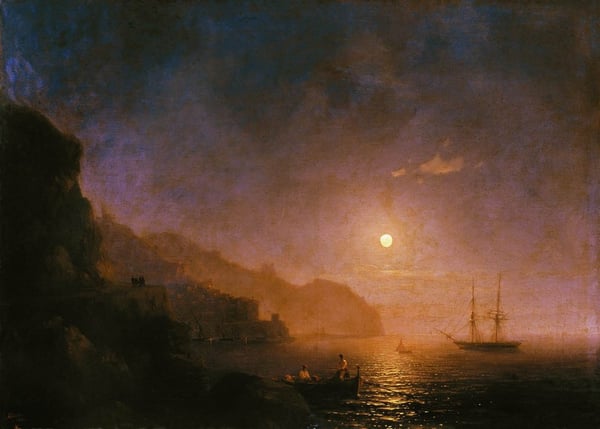
Expertenanalyse zu Ivan Aivazovskys Night in Amalfi
Stil: Romanticism · Genre: landscape
Expert Art Historical Analysis: "Night in Amalfi" by Ivan Aivazovsky
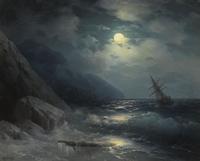
Within the framework of Romanticism, Ivan Aivazovsky’s Night in Amalfi stands as a quintessential example of the movement’s fascination with the sublime power and poetic beauty of nature. As a landscape (specifically a marine or coastal nocturne), the work transcends mere topographical representation, instead using the interplay of moonlight, sea, and sky to evoke deep emotional resonance and a sense of awe.
Significance within Romanticism and Landscape Genre:
-
Emotional Sublimity: Romantic landscape painting prioritized mood and feeling over precise documentation. In Night in Amalfi, Aivazovsky harnesses the dramatic contrast between the deep, velvety darkness of the night sky and the shimmering, silvery path of moonlight across the water. This luminous effect is not just decorative; it creates a contemplative, almost melancholic atmosphere, inviting the viewer into a moment of quiet introspection—a core Romantic aim.
-
Mastery of Atmosphere and Light: Aivazovsky was renowned for his ability to render the sea and light with unparalleled fluidity. This painting exemplifies his signature technique: the moon’s glow is captured through translucent glazes, making the water appear to breathe and move. The soft, diffused light enveloping the Amalfi coastline merges the solid forms of cliffs and architecture with the ethereal sea, blurring the boundary between earth and firmament—a Romantic trope of the infinite.
-
Celebration of Untamed Nature: Unlike the glowing, idyllic landscapes of earlier Neoclassicism, Romantic landscapes often depicted nature as powerful, mysterious, and indifferent. Here, the calm night still holds a latent energy; the dark expanse of the sea suggests depth and the unknown. The small, silhouetted boats and distant lights of Amalfi remind us of human presence within a vast, untamable world—a key Romantic theme of humanity’s smallness in the face of nature’s majesty.
-
Cultural and Temporal Specificity: Amalfi, a historic coastal town, provides a specific locus for a universal Romantic experience. By setting the scene at night, Aivazovsky transforms a familiar Mediterranean locale into a timeless, dreamlike vision. This choice aligns with Romanticism’s interest in the exotic and the evocative power of nocturnal landscapes, where imagination reigns over daylight clarity.
In summary, Night in Amalfi is significant because it perfectly synthesizes Aivazovsky’s technical virtuosity with Romanticism’s core ideals: the elevation of emotion, the reverence for nature’s sublime beauty, and the creation of an immersive, atmospheric experience that lingers in the viewer’s memory long after the painting is left behind.
Visuell ähnlich
20 Werke mit ähnlicher Komposition und Farbpalette
Crimean view. Ayu-Dag
Ivan Aivazovsky

Sea at night
Ivan Aivazovsky

View Of The Ayu Dag, Crimea
Ivan Aivazovsky
Moonlight on the Bosphorus
Ivan Aivazovsky
The Bay of Naples by Moonlight
Ivan Aivazovsky
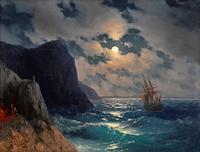
Passing Ship on a Moonlit Night
Ivan Aivazovsky
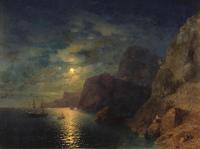
Sea at night
Ivan Aivazovsky

Sea coast. Farewell
Ivan Aivazovsky
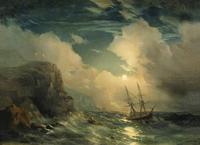
Seascape
Ivan Aivazovsky

View of the sea at night
Ivan Aivazovsky
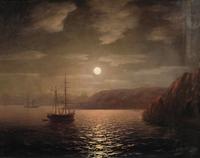
Lunar night on the Black sea
Ivan Aivazovsky

Smugglers
Ivan Aivazovsky

Island of Ischia
Ivan Aivazovsky
Moonlit Landscape with a Ship
Ivan Aivazovsky

Seascape. Koktebel.
Ivan Aivazovsky

Shipwreck near Gurzuf
Ivan Aivazovsky

Crimean Tartars on the Sea Shore
Ivan Aivazovsky

The sunset on sea
Ivan Aivazovsky

The Bay of Naples by Moonlight
Ivan Aivazovsky

Seascape
Ivan Aivazovsky