Expertenanalyse zu Ivan Aivazovskys Pyramids
Stil: Romanticism · Genre: landscape
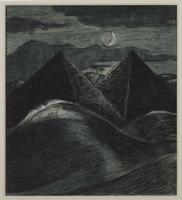
Expert Art Historical Analysis: "Pyramids" by Ivan Aivazovsky
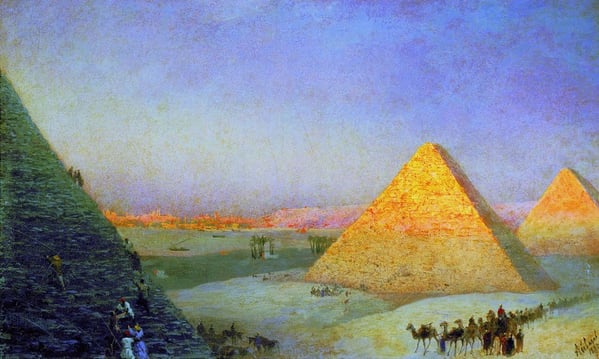
Ivan Aivazovsky (1817–1900) is celebrated as the foremost master of marine Romanticism, but his lesser‑known landscape "Pyramids" (likely dating to his travels in the Near East or inspired by contemporary Orientalist imagery) demonstrates how he applied the core tenets of Romanticism—sublimity, sublime atmosphere, and emotional resonance—to a non‑marine subject.
Romanticism and the Sublime in Landscape
The Romantic movement prized the overwhelming power of nature and the evocation of awe. In "Pyramids," Aivazovsky transforms the ancient Egyptian monuments into a vehicle for the sublime. The pyramids are not rendered as static archaeological relics; instead, they appear as colossal, almost supernatural forms against a dramatic sky. The interplay of light and shadow—a hallmark of Aivazovsky’s technique—creates a luminous, almost ethereal atmosphere that dwarfs any human presence (if depicted). This treatment aligns with Romanticism’s fascination with the infinite, the ancient, and the mysterious.
Significance Within Aivazovsky’s Oeuvre
While Aivazovsky is primarily known for storm‑tossed seas and moonlit coastal scenes, "Pyramids" demonstrates his versatility and his engagement with Orientalism—a Romantic sub‑genre that idealized and exoticized Eastern cultures. The painting reflects 19th‑century European curiosity about Egypt, spurred by Napoleon’s campaigns and subsequent archaeological discoveries. By applying his signature luminous palette and atmospheric perspective to a desert landscape, Aivazovsky proves that Romantic sublimity could be as powerful in a calm, ancient setting as on a raging ocean.
Technical Mastery and Emotional Impact
Aivazovsky’s ability to render subtle gradations of light—from the golden glow on the pyramid faces to the violet shadows in the hollows—gives the scene a palpable sense of time and temperature. The sky, often the emotional center of his compositions, here stretches endlessly, emphasizing the solitude and permanence of the pyramids. This combination of meticulous detail and broad, atmospheric washes is what makes the work significant: it captures both the physical grandeur of the site and the Romantic longing for transcendence.
In conclusion, "Pyramids" is a significant example of how a major Romantic artist extended his signature sensibility—dramatic light, emotional atmosphere, and the sublime—beyond the sea to a terrestrial, ancient subject, enriching the Romantic landscape tradition with a powerful Orientalist vision.
Visuell ähnlich
20 Werke mit ähnlicher Komposition und Farbpalette

The Great Pyramid at Giza
Ivan Aivazovsky

The Pyramids
John Varley II
At the Pyramids
Winston Churchill
View in Egypt
Luigi Mayer

Great Pyramids of Cheops and Chephren
Vasily Polenov

View of the Pyramids of Giza
Robert Alott
Near the Pyramids
Winston Churchill
Egypt. Pyramids
Ivan Bilibin

Memories of Giza
Eugen Bracht

Egypt
Nicholas Roerich

Pyramiderna vid Giza från Nilens strand
Georg von Rosen
Pyramids of Giza
Ferdinand Knab

The Sphinx and the Pyramids
Augustus Osborne Lamplough

Egyptian Fantasy
Hubert Robert

The Pyramids in Gizeh
John Varley II

The sphinx of Geezah
Carl Haag
Distant View of the Pyramids
Winston Churchill

Sfinxen i Giza
Georg von Rosen

Bonaparte Before the Sphinx
Jean-Leon Gerome
The Pyramids in the Sea
Paul Nash