
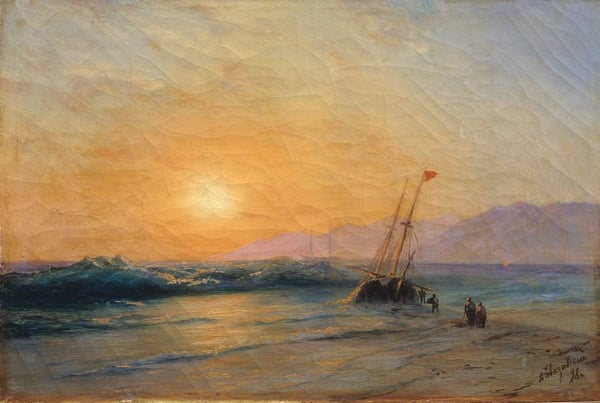
Analisi esperta di Sunset at Sea di Ivan Aivazovsky
Stile: Romanticism · Genere: marina
Expert Analysis: "Sunset at Sea" by Ivan Aivazovsky
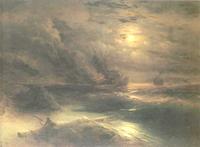
Ivan Aivazovsky (1817–1900) was the undisputed master of the Romantic marine painting, or marina, and "Sunset at Sea" stands as a quintessential example of his enduring significance within the Romantic movement. The artwork captures a fleeting, dramatic moment when the last rays of the sun meet the boundless ocean, transforming the scene into a sublime spectacle of light, color, and atmosphere.
What makes this work significant within Romanticism:
-
The Sublime Power of Nature: Aivazovsky’s portrayal of the sea is not merely descriptive—it is emotional and overwhelming. The vast expanse of water, the fiery sky, and the impending dusk evoke a sense of the sublime, a core Romantic concept in which nature’s grandeur simultaneously inspires awe and a recognition of human smallness. The scene is devoid of narrative human drama; the sea and sky alone carry the emotional weight.
-
Mastery of Light and Color: Aivazovsky was celebrated for his ability to render light with an almost phosphorescent brilliance. In "Sunset at Sea," the warm orange, gold, and crimson hues of the setting sun transition into cool purples and deep blues as they meet the water. This chromatic harmony creates a luminous, almost ethereal quality—proof of the artist’s technical virtuosity and his Romantic fascination with the transient, poetic beauty of natural phenomena.
-
Atmospheric Perspective and Drama: The horizon line is low, allowing the sky to dominate the composition. Aivazovsky employs a soft, diffused brushstroke to capture misty clouds and gentle waves, contrasting with sharper reflections on the water’s surface. This interplay between haziness and clarity heightens the dramatic tension between light and dark, calm and potential storm—a hallmark of Romantic marine painting.
-
Innovation within the Marina Genre: While earlier marine painters often focused on shipwrecks, naval battles, or port scenes, Aivazovsky elevated the genre by making the sea itself the primary subject—an autonomous, living force. "Sunset at Sea" exemplifies this shift: there are no ships or figures, only the raw, atmospheric dialogue between sun, sky, and ocean. This focus on pure natural spectacle places him as a pivotal figure between Romanticism and later Impressionist concerns with light and mood.
Conclusion:
"Sunset at Sea" is significant not only for its breathtaking beauty but for how it encapsulates Romanticism’s deepest preoccupations—the sublime, the transient, and the overpowering majesty of nature. Aivazovsky’s technical brilliance in rendering luminous seascapes solidified his reputation as the greatest Romantic marine painter of the 19th century, and this work remains a masterful testament to that legacy.
Visivamente simili
20 opere con composizione e palette affini
Sand Pebbles
Ivan Aivazovsky
Sea view
Ivan Aivazovsky

View from Cap Martin with Monaco in the Distance
Ivan Aivazovsky

Island of Ischia
Ivan Aivazovsky

Seascape. Koktebel.
Ivan Aivazovsky
Agitated sea
Ivan Aivazovsky

Shipwreck near Gurzuf
Ivan Aivazovsky
View Of The Ayu Dag, Crimea
Ivan Aivazovsky
The Bay of Naples by Moonlight
Ivan Aivazovsky

Sailors Coming Ashore
Ivan Aivazovsky
Sailing ships
Konstantinos Volanakis

Near Crimean coast
Ivan Aivazovsky
Watching Ships at Sunset
Ivan Aivazovsky

Moonrise in Feodosia
Ivan Aivazovsky
Tempest by coast of Odessa
Ivan Aivazovsky
Sea on the mountains background
Ivan Aivazovsky

The Moonrize in Feodosiya
Ivan Aivazovsky
Sea before storm
Ivan Aivazovsky
Seascape
Ivan Aivazovsky
Cristofor Columb
Ivan Aivazovsky