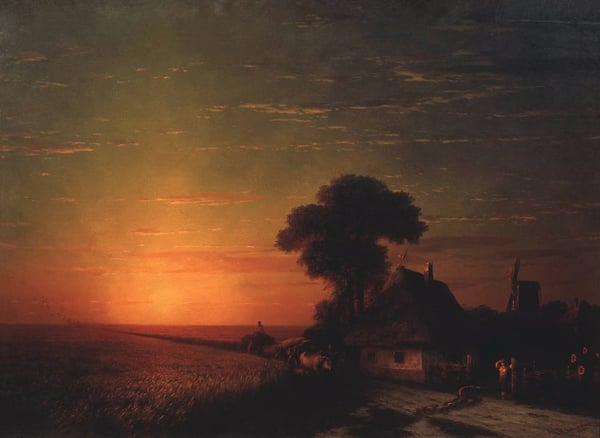
Expert analysis of Ivan Aivazovsky’s Sunset in Little Russia
Style: Romanticism · Genre: landscape
Expert Art Historical Analysis: "Sunset in Little Russia" by Ivan Aivazovsky
Ivan Aivazovsky (1817–1900) is celebrated as the supreme Romantic painter of the sea, but Sunset in Little Russia demonstrates his masterful command of the inland landscape—a departure that underscores the breadth of his Romantic vision. Executed within the style of Romanticism, the work channels the movement’s core preoccupation with nature’s sublime power, transience, and emotional resonance.
Significance within Romanticism and the Artist’s Oeuvre
-
Romantic Sublimity through Atmosphere: The painting likely centers on a dramatic, glowing sunset over the Ukrainian plains (the historical region of “Little Russia,” now central/eastern Ukraine). Aivazovsky uses the fleeting light of dusk to evoke the Romantic fascination with the infinite and the ephemeral. The sky becomes a stage for shifting colors—gold, crimson, violet—that pull the viewer into a contemplative, almost spiritual experience of nature.
-
Expansion of Aivazovsky’s Genre: While Aivazovsky is best known for turbulent seascapes (e.g., The Ninth Wave), this landscape proves his versatility. By turning his brush to the flat expanses of “Little Russia,” he applies the same luminous, atmospheric technique that made his marine scenes iconic. The significance lies in how he adapts his Romantic vocabulary—light, color, horizon—to a calm pastoral subject, proving that the sublime exists not only in storms but also in the quiet grandeur of a sunset.
-
Cultural and Historical Context: The title “Little Russia” references the 19th-century imperial Russian designation for Ukraine. In choosing this subject, Aivazovsky (himself of Armenian origin but raised in Crimea) aligns with Romantic nationalism’s interest in local, “authentic” landscapes. The work becomes a visual ode to the vast, fertile steppe, imbued with a nostalgia and reverence characteristic of Romanticism’s search for national identity and emotional connection to one’s homeland.
-
Technical Mastery: Aivazovsky’s hallmark—the translucent layering of glazes to simulate the glow of sunlight—is likely on full display. The horizontality of the plains and the expansive sky create a sense of limitless space, a Romantic device used to dwarf the human figure (if any) and emphasize humanity’s smallness before nature.
Conclusion: Sunset in Little Russia is significant as a testament to Aivazovsky’s ability to transcend his marine specialty while remaining a quintessential Romantic. It captures the movement’s ideal: nature as a mirror for emotion, time as fleeting, and the landscape as a vessel for the sublime. The work stands as a refined example of how Romantic landscape painting can transform a simple sunset into a profound meditation on light, land, and memory.
Visually similar
20 works with related composition and palette
Ukrainian Landscape at Night
Ivan Aivazovsky

Ukrainian landscape with chumaks in the moonlight
Ivan Aivazovsky
Rural Idyl by a Pond
Léon-Victor Dupré
Moonlit Night
Aleksey Savrasov

Village Scene, Sunset
Jules Dupre
Night in the Ukraine
Ivan Aivazovsky
Normandy farms
Theodore Rousseau

Sunset, Amagansett
Thomas Moran
Country Scene
Aleksey Savrasov

Sunset Amagansett
Thomas Moran
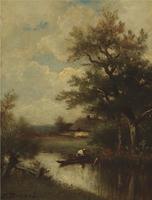
Return of the fisherman
Jules Dupre
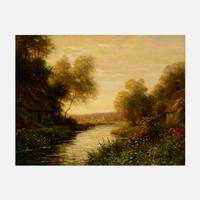
Stream in Fading Light
Louis Aston Knight

A Country Inn
George Morland

Harvest Scene - Valley of the Delaware
William Hart
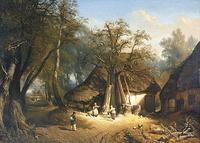
Scene
Karl Joseph Kuwasseg
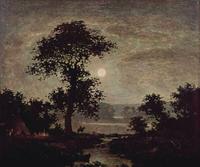
Mondlicht
Ralph Blakelock

Before a Thunderstorm
Fyodor Vasilyev
In theSalt Marshes of N. J.
James Hamilton

Sunset on Long Island
Thomas Moran
View in the Woods at Sunset
Louwrens Hanedoes