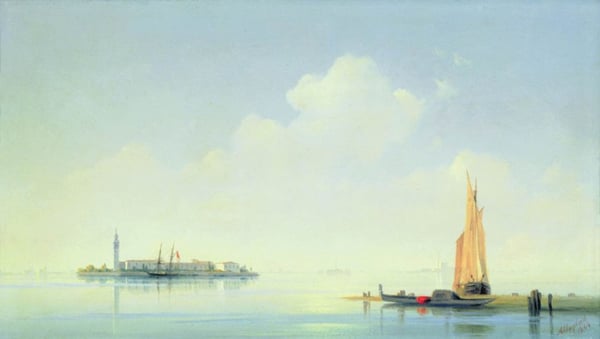
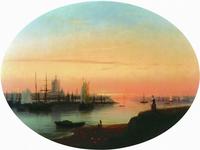
Ivan Aivazovsky’s The Harbour of Venice, the Island of San Giorgio is a masterful synthesis of Romanticism’s emotional intensity with the precise observation of a cityscape. While Aivazovsky is celebrated primarily as a marine painter, this work shifts his signature focus on the sublime power of the sea to the sublime beauty of an urban waterfront, filtered through the Romantic lens of atmosphere and light.
The painting’s significance lies in how it applies Romanticism’s core principles—awe before nature, dramatic chiaroscuro, and the evocation of mood—to a topographically specific view. Instead of a storm-tossed ocean, Aivazovsky captures the serene yet luminous quality of the Venetian lagoon. The island of San Giorgio Maggiore, with its iconic Palladian church, is not merely a landmark; it becomes a quiet protagonist softened by mist and reflected in the placid water. This treatment elevates the scene beyond mere documentation: the harbour glows with a golden, almost ethereal light, transforming a familiar tourist vista into a Romantic meditation on transience and beauty.
Genrewise, the cityscape here is infused with the painter’s marine expertise—the water is alive with subtle reflections and ripples, the sky a vast theatre of clouds and fading sunlight. For Romanticism, this work is significant because it demonstrates that the genre of cityscape can achieve the same poetic, emotionally resonant effects as a dramatic seascape. Aivazovsky proves that even a quiet harbour, rendered with his trademark mastery of light and atmosphere, can inspire the same sense of wonder as the wildest ocean.