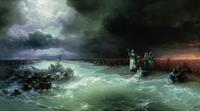
Artwork Analysis: "Travel of Poseidon by Sea" by Ivan Aivazovsky
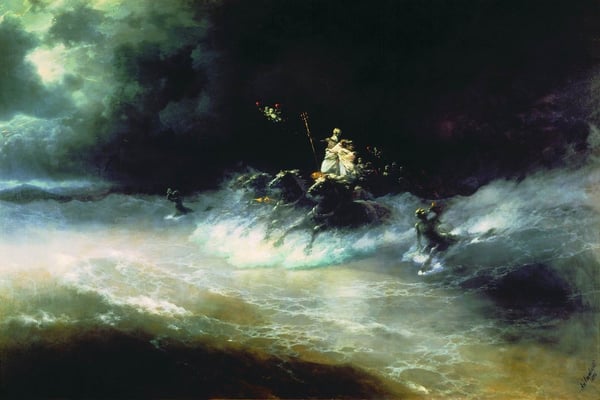
Ivan Aivazovsky’s “Travel of Poseidon by Sea” is a striking example of Romanticism applied to mythological painting, where the artist’s signature mastery of marine elements merges with classical grandeur. The work’s significance lies in how Aivazovsky translates the Romantic fascination with nature’s sublime power into a mythological narrative, making the sea itself the true protagonist.
In this piece, the Greek god Poseidon is depicted not merely as a static figure but as an elemental force in motion—his chariot riding over turbulent waves while the sky churns with dramatic clouds. Aivazovsky, renowned for his luminous seascapes, employs his exceptional skill in rendering light and atmosphere: the glowing horizon contrasts with the dark, foaming sea, heightening the sense of awe and danger. The mythological subject allows him to push Romanticism’s emotional intensity further, as Poseidon’s journey becomes a visual metaphor for the untamed, majestic power of the ocean—a power both beautiful and terrifying.
Within the context of Romanticism, this painting stands out because it transforms a classical myth into an experience of the sublime. Aivazovsky’s attention to the interplay of water, light, and sky elevates the scene beyond mere illustration, creating a dynamic composition where divine presence is inseparable from the natural world. The work thus underscores the Romantic ideal: that the forces of nature, whether gods or storms, reveal something profound and uncontainable about the human spirit.