Expert Analysis of Mars Disarmed by Venus and the Three Graces by Jacques-Louis David
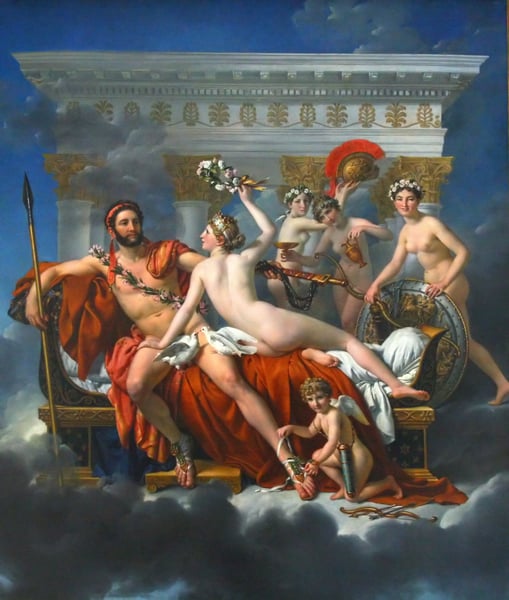
As a quintessential example of Neoclassicism in the mythological genre, Jacques-Louis David’s Mars Disarmed by Venus and the Three Graces holds profound significance both within the artist’s career and the broader arc of the movement. Painted in 1824, this work marks a departure from David’s earlier, severe Republican moralizing—such as The Oath of the Horatii—toward a softer, more decorative sensibility that still adheres to Neoclassical ideals of clarity, line, and ordered composition.
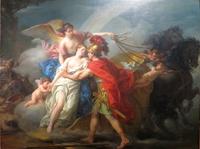
The painting’s mythological subject—Venus and the Three Graces disarming the god of war, Mars—is a deliberate allegorical inversion of traditional heroic themes. Instead of a martial triumph, David presents love and beauty as forces that pacify violence. This shift reflects the late phase of Neoclassicism, where the movement’s rigid moralism gave way to a more sensual, even Rococo-influenced aesthetic, yet retained the sculptural precision and cool palette characteristic of the style. The figures are arranged with geometric harmony: Venus sits at center, her pose a study in contrapposto, while the Graces gracefully remove Mars’s helmet and shield. David’s brushwork is smooth, the forms idealized, and the lighting clear—hallmarks of Neoclassical technique that elevate a playful narrative into a stately, timeless tableau.
What makes this work significant is precisely this synthesis: it demonstrates how Neoclassicism, even in its later, more hedonistic manifestations, never abandoned its commitment to rational structure and moral allegory. David, the former revolutionary painter, here reimagines mythological convention not as a call to civic duty but as a meditation on the civilizing power of love—a poignant coda for an artist who had witnessed the rise and fall of empires. The painting thus stands as a testament to the enduring flexibility of Neoclassical ideals, proving that the style could accommodate grace and intimacy as readily as heroism and austerity.