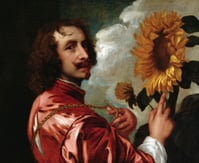
Expert analysis of Anthony van Dyck’s Snyders
Style: Baroque · Genre: portrait
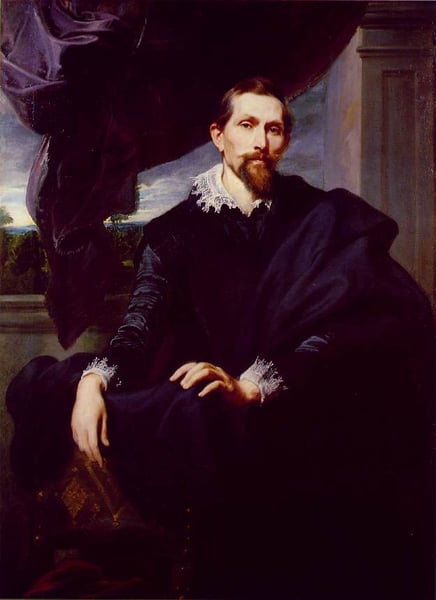
Anthony van Dyck's "Snyders" is a masterful Baroque portrait that elevates the genre beyond mere likeness into a dynamic study of character and artistic kinship. Painted during the artist's Antwerp period (circa 1620–1621), this work captures Frans Snyders, the renowned Flemish still-life and animal painter, who was both a colleague and friend of van Dyck.
As a Baroque portrait, the painting embodies the era's hallmark qualities: psychological depth, theatrical presence, and a rich, expressive handling of light and texture. Van Dyck, who later became the leading court portraitist at the court of Charles I of England, here demonstrates his early command of creating an immediate, engaging connection between sitter and viewer. The composition is intimate yet dignified—Snyders is shown half-length, turned slightly, with a direct gaze that conveys both intellect and self-assurance. The subtle play of light across his face and hands, set against a dark background, typifies van Dyck's ability to model form with soft, fluid brushwork while retaining a sense of aristocratic ease.
What makes this portrait significant is how it functions as a dialogue between two giants of Flemish Baroque art. Van Dyck, himself a prodigy who had worked with Peter Paul Rubens, pays homage to Snyders—the master of opulent still lifes and hunting scenes—by presenting him not merely as a craftsman but as a thoughtful, influential figure. The painting also marks a pivotal moment in van Dyck's development: his shift from the energetic, Rubens-inspired style of his youth toward the refined, psychologically penetrating portraiture that would define his career. In "Snyders," the Baroque love for dynamism is channeled not through dramatic action, but through the sitter's alert expression and the tactile richness of fabric and flesh, making this work a quiet yet powerful testament to the artist's genius in capturing both the person and the persona.
Visually similar
20 works with related composition and palette
Marcello Sacchetti
Pietro da Cortona
Sir Thomas Aylesbury
William Dobson
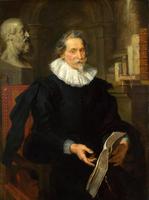
Portrait of Ludovicus Nonnius
Peter Paul Rubens
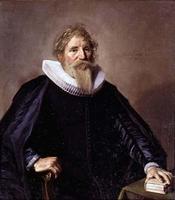
Portrait of a Man
Frans Hals
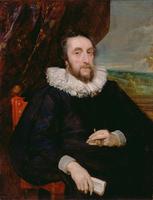
Thomas Howard, Second Earl of Arundel
Anthony van Dyck
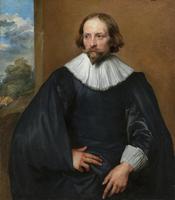
Portrait Of Quintijn Symons
Anthony van Dyck
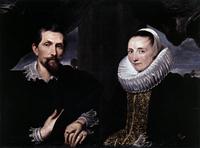
Double Portrait of the Painter Frans Snyders and his Wife
Anthony van Dyck
Portrait of a Gentleman Dressed in Black, in Front of a Pillar
Anthony van Dyck
John Cotton
Daniel Mytens the Elder
Portrait of a Man
Cornelis de Vos
Portrait of Nicolaes Ruts
Rembrandt
Portrait of Gaspard Schoppins
Peter Paul Rubens
Portrait of Johan Wierts
Jacob Jordaens
Portrait of Joost de Hertoghe
Anthony van Dyck
Portrait d'homme au pourpoint noir et à la collerette blanche
Thomas de Keyser
Nicolas Lanier
Anthony van Dyck
Pieter Stevens
Anthony van Dyck
Portrait of Giovanni Vincenzo Imperiale
Anthony van Dyck
Portrait of a Man
Ferdinand Bol
Nicolaes Woutersz van der Meer
Frans Hals